
Reviewed · HISTORICAL TOURS
2-Hour Historical Walking Tour from Dublin
Dublin’s story comes into focus on this compact walk, which links Viking settlement, English rule, religious conflict, revolution, and modern Ireland. You start opposite Trinity College and finish near Christ Church Cathedral, passing many of the city center’s most important sites along the way.
I like the small group limit of 25, which makes it easier to hear the guide and ask questions. I also like the mix of famous places and less obvious historical points, such as the Viking remains beneath Wood Quay and the Civil War connection at the Four Courts.
The main consideration is the depth of the history. Guides such as Jody, Eoin, John, and Caolan bring plenty of energy, humor, and detail, but this is not a light sightseeing stroll. If you prefer culture, food, or architecture with only a little politics, two hours of Irish history may feel dense.
Key points to know before booking
- Meet at the Grattan statue: The starting point is opposite Trinity College’s front gate at College Green, not inside the gate itself.
- Expect serious history: Guides are history postgraduates, and the tour covers Ireland from Viking Dublin through recent political events.
- Book early in busy periods: The tour is often booked about 21 days ahead, so last-minute spaces may be limited.
- No Book of Kells admission: You learn about the manuscript and Trinity College, but entry to the Book of Kells exhibition is not included.
- Allow more than two hours: The planned time is about two hours, though some walks have run 30 minutes longer.
- Wear sensible shoes: The distance is manageable, but you are on your feet for the full walk and Dublin weather can be cold, wet, or windy.
Why this is a useful first Dublin tour
I would put this walk near the beginning of a Dublin visit. It gives you a working map of the central city while explaining why the streets, statues, courts, churches, and government buildings matter.
The route also helps you sort out Ireland’s overlapping stories. You hear about Vikings, medieval English rule, Protestant political power, Catholic emancipation, the War of Independence, the 1921 Treaty, and the Civil War that followed. That context makes later visits to Dublin Castle, Kilmainham Gaol, the General Post Office, and other sites easier to understand.
This is not a tour built around entering a long list of attractions. Most stops are viewed from outside, and the walk uses the city itself as the classroom. That keeps the price down to $22.98 per person and leaves the rest of your day open.
The tradeoff is clear: you receive a lot of explanation for a low price, but you do not get extended time inside the Book of Kells, Christ Church Cathedral, or Dublin Castle. I see this as an orientation walk rather than a complete visit to each attraction.
More Walking Tours in Dublin
- Dublin Highlights and Hidden Gems Guided Walking Tour
★ 5.0 · 6,020 reviews - Dublin: Highlights and Hidden Gems Walking Tour
★ 4.9 · 2,140 reviews - 1916 Rebellion Walking Tour
★ 5.0 · 1,605 reviews
Trinity College and the Book of Kells
The tour begins at the Henry Grattan Monument, near the Grattan statue on College Green. This meeting point is easy to find if you look for the statue opposite Trinity College’s front gate.
The first stop takes about 20 minutes and introduces Trinity College, founded in 1592 as Ireland’s oldest university. The guide also explains the Book of Kells, an eighth-century manuscript containing the four Gospels in Latin.
The Book of Kells is not included in the tour price. That is important if you expect to see the manuscript itself. Instead, you receive the historical setting first, then you can decide if you want to return later and pay for admission on your own.
I like this opening because Trinity is not treated as just a handsome entrance and old stone walls. You learn why the university matters in Irish education and politics, and why the Book of Kells carries such weight. If you want a detailed look at the manuscript exhibition, plan a separate visit.
Bank of Ireland and Protestant political power
From Trinity, the walk moves to the Bank of Ireland, a building with a political past that is easy to miss if you only admire its neoclassical exterior.
The building was originally Ireland’s colonial parliament, completed in 1729. That parliament was abolished by the Act of Union in 1800, and the site now helps explain the period known as the Protestant Ascendancy.
This stop is brief, about 10 minutes, but it gives the route a useful change of scale. You move from a university and manuscript to the institutions that controlled Ireland’s political life. The building is not just an architectural landmark. It represents who had power, who was excluded, and how British rule operated in Ireland.
For me, this is where the tour’s political focus becomes clear. If you want a simple introduction to Dublin’s buildings, the discussion may feel heavy. If you want to understand why Irish history is so often shaped by religion and government, this stop earns its place.
Temple Bar beyond the pubs
Temple Bar is now one of Dublin’s best-known areas, but the guide explains that its current role was not inevitable. The narrow-street district was once marked for demolition before being repurposed as Dublin’s Cultural Quarter in the 1990s.
The stop lasts around 10 minutes. You should not expect a pub crawl or a long pause for food. Instead, you get the story of how an area threatened with removal became one of the city’s most visited districts.
That short explanation is valuable because Temple Bar can otherwise feel like a tourist zone disconnected from the rest of Dublin. The tour places it in a recent urban story: plans change, old districts gain new uses, and a city’s identity can be reshaped within a generation.
I would save your photographs, drinks, and shopping for after the walk. The group keeps moving, and this stop is about the district’s change rather than its nightlife.
More walking routes in Dublin:
- 90 Minute Dublin Walking tour and Sightseeing tips
★ 5.0 · 916 reviews - Historical 2-Hour Guided Walking Tour of Dublin
★ 4.7 · 865 reviews - Dublin Traditional Irish 3 Course Meal Walking Tour with Local
★ 5.0 · 755 reviews - Dublin: Mythology, Folklore and Legends Walking Tour
★ 4.9 · 703 reviews
Wood Quay and Viking Dublin
At Wood Quay Amphitheatre, the guide turns to the city’s Viking origins. Extensive archaeological work took place here in the 1980s, uncovering evidence of the Viking city founded in AD 840.
This is one of the route’s most interesting stops because the visible modern city does not reveal much about the settlement beneath it. The guide connects the riverfront area with Dublin’s earliest urban development and the meaning behind the city’s name.
Dublin comes from Dubh Linn, meaning Black Pool. That detail returns later at Dublin Castle, where the original pool was located. The route works well because it repeats and connects ideas instead of presenting eight unrelated facts.
You spend about 10 minutes at Wood Quay. Do not expect an archaeological site visit or a museum display as part of the walk. The value comes from learning how much of Dublin’s early story was recovered through excavation and how the Viking settlement shaped the city that followed.
The Four Courts and the Civil War
The 20-minute stop at the Four Courts gives the tour one of its clearest links to modern Irish history. This is Ireland’s legal headquarters, but it is also tied directly to the Civil War that began in June 1922.
The conflict divided those who supported the Treaty of December 1921 from those who opposed it. That Treaty ended the War of Independence from 1919 to 1921, but it did not settle the future of Ireland peacefully.
I find this stop especially useful because it explains that independence was not a single clean finish line. The political arguments continued after the Treaty, and the Four Courts became a major setting in the conflict.
This is also where the pace may slow. The guide can spend a good deal of time explaining people, factions, and events. The information is important, but it asks you to listen closely. If dates and political disputes wear you down, this is one section to prepare for.
Christ Church Cathedral and Strongbow
Christ Church Cathedral is Dublin’s oldest cathedral, founded in 1030. The existing stone building was rebuilt in the 1170s by Strongbow, the Anglo-Norman figure linked to the original English invasion of that period.
The tour spends about 10 minutes here and finishes at Christchurch Place, near the cathedral. The route does not include cathedral admission, so you see the exterior and learn the political and religious setting before deciding if you want to go inside later.
This stop ties medieval Dublin to the story of English involvement in Ireland. Strongbow is not presented as a detached medieval character. His building work and military role connect the cathedral to the first stages of English invasion and control.
The ending location is practical. You are near Christ Church, Dublin Castle, and other central attractions, so you can continue exploring without a long journey back to the start.
City Hall and Daniel O’Connell
At City Hall, the guide points out the statue of Daniel O’Connell inside the building. O’Connell became Dublin’s first Catholic Lord Mayor in 1840 and led the campaign for Catholic Emancipation in 1829.
That campaign ended anti-Catholic laws and earned him the title The Liberator. The stop is short, around 10 minutes, but O’Connell gives the guide a strong way to explain the struggle for Catholic rights.
This is one of the tour’s better examples of using a person to explain a large political change. Instead of hearing only about legislation, you connect the change to a major public figure and Dublin’s civic life.
City Hall also adds variety to the route. After churches, courts, and old government buildings, you get a closer look at how civic identity and political leadership were represented.
Dublin Castle and the Black Pool
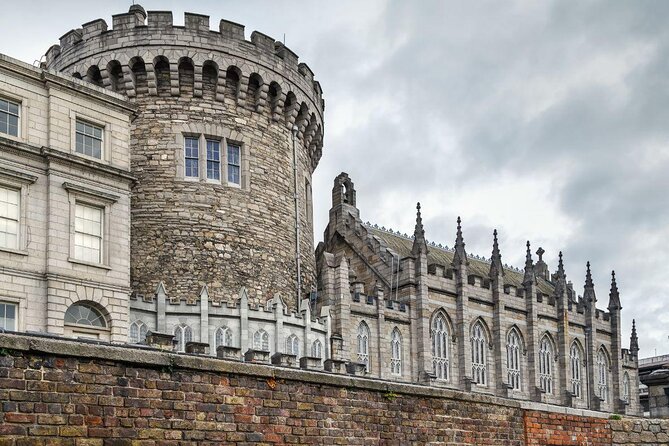
The final listed stop is Dublin Castle, originally built by King John in 1204. It served as the seat of British administration until 1922, making it central to the story of colonial rule and the transfer of power.
The castle also marks the location of the Dubh Linn, the Black Pool that gave Dublin its name. I like this return to the Viking story because it shows how different periods overlap in the same small area.
You spend about 10 minutes here. Again, the tour does not include entry to the castle. If you want to explore the state apartments or other interior areas, you need to arrange a separate visit.
Ending near the castle and Christ Church gives you several good options for the rest of the day. You can continue on foot, stop for lunch, visit one of the sites, or simply use the new map in your head to plan the next part of your Dublin stay.
The guides and the tone of the walk
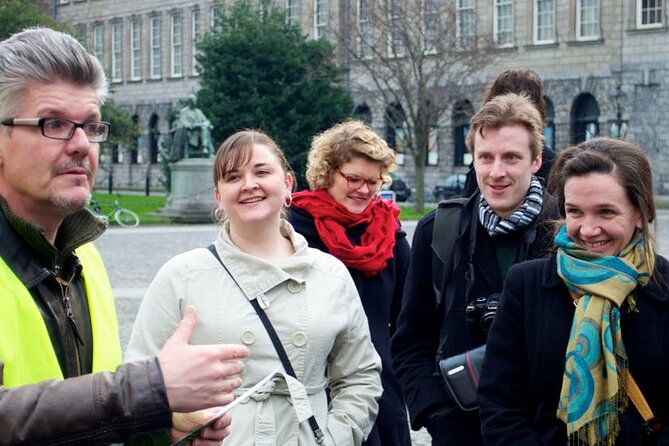
All guides are history postgraduates, and that shapes the experience. Jody is described as an animated storyteller with strong knowledge stretching from Celtic settlement to modern events, including Brexit. Eoin is praised for making a rainy, windy morning worthwhile and for explaining a broad outline before adding detail. John is noted for his humor and ability to keep a group engaged for two and a half hours.
Other named guides include Daragh, Colm, and Caolan Maher. The exact guide depends on the departure, but the common thread is a serious interest in Irish history with an effort to keep the material lively.
The best guides use jokes, stories, songs, and clear explanations. You may hear a quick overview of 5,000 years of Dublin before stopping for a closer look at each site. That structure helps you place the details in order.
Still, do not book this expecting a shallow introduction. One guide may be especially detailed, and the walk can run beyond two hours. The group has included people who found the political material too dense, so I would choose another tour if your priority is casual sightseeing.
Price, timing, and practical comfort
At $22.98 per person, this is a strong value if you want historical context without spending half a day. The group size can reach 25, so it is not a private walk, but the limit is still small enough for a guide to address the group rather than speak to a crowd.
The scheduled duration is about two hours. Several walks have lasted longer, including one reported at two and a half hours, so avoid booking a tight appointment immediately afterward.
The route requires a moderate level of fitness. You walk between the stops and remain on your feet throughout, so comfortable shoes matter. Dublin weather can be freezing, rainy, or windy even when the calendar suggests otherwise. Bring suitable layers and rain protection.
The experience is offered in English and includes a mobile ticket. It is near public transportation, and service animals are allowed. Confirmation arrives when you book.
The cancellation policy is generous if your plans change: cancel at least 24 hours before the local start time for a full refund. Changes or cancellations inside that 24-hour window are not accepted for a refund.
Pay close attention to the meeting point. The correct place is the Henry Grattan Monument at College Green, opposite Trinity College’s front gate. It is not the gate itself. A previous missed tour resulted from confusion over this detail, so check the map and arrive early.
Who should book this Dublin walk?
I would book it if you want the political and historical framework behind Dublin’s main sights. It suits adults, older children, and teenagers who can listen for two hours and follow a story involving religion, colonial government, independence, and civil conflict.
It is also a smart choice on your first day. You can revisit Trinity College, Temple Bar, Dublin Castle, or Christ Church later with more context and decide which interiors deserve your time and admission fee.
I would skip it if you want a relaxed architecture walk, a food-focused outing, or a short introduction with only a few dates. The history comes first here, and the detail is part of the bargain.
Should you book the 2-Hour Historical Walking Tour?
Book this walk for value, orientation, and serious Irish history. For about $23, you cover a useful stretch of central Dublin with a history postgraduate and finish near several major sights.
Just arrive at the Grattan statue, dress for poor weather, wear comfortable shoes, and leave your afternoon flexible. If you enjoy stories about power, religion, invasion, independence, and political change, this tour can give your Dublin visit a strong foundation. If you want a lighter stroll, choose something less focused on history.
FAQ
How long is the walking tour?
The planned duration is approximately two hours. Some tours have lasted around two and a half hours, so avoid scheduling an immediate appointment afterward.
Where does the tour begin?
It begins at the Henry Grattan Monument, near the Grattan statue at College Green, opposite Trinity College’s front gate in Dublin.
Where does the tour finish?
The tour ends at Christ Church Cathedral on Christchurch Place, near Wood Quay.
Is entry to the Book of Kells included?
No. The tour explains Trinity College and the Book of Kells, but admission to the Book of Kells is not included.
Is Dublin Castle admission included?
The tour visits Dublin Castle as an outdoor stop, but the provided information does not include admission to the castle’s interior.
How many people can join the group?
The tour has a maximum of 25 participants.
What language is the tour offered in?
The tour is offered in English.
How much does the tour cost?
The listed price is $22.98 per person.
What level of fitness is required?
A moderate level of physical fitness is recommended. You walk between several central Dublin sites and remain on your feet for much of the experience.
Can I cancel for a full refund?
Yes. You must cancel at least 24 hours before the experience’s local start time for a full refund. Cancellations or changes made less than 24 hours before the start are not accepted for a refund.
More history tours in Dublin
- Dublin Historical Centre Food Tour with 8 Food Tastings & Drinks
★ 5.0 · 1,718 reviews - Dublin to Cork, Blarney Castle & Cóbh Heritage Centre by train
★ 4.5 · 510 reviews - Dublin: Jeanie Johnston Tall Ship Irish Famine History Tour
★ 4.8 · 431 reviews - Dublin’s Haunted History Walking Tour
★ 4.3 · 345 reviews
Just added around Dublin
- Gin School, distill you own gin, cocktails, tastings, food★ 5.0 · 8 reviews
- Dublin : Street Art Walking Tour★ 5.0 · 3 reviews
- Dublin: Personal Photographer- Travel Photography Experience★ 4.5 · 8 reviews
- Dublin: Skip-the-line Book of Kells & Old Town Private Tour★ 5.0 · 6 reviews
- Dublin: Howth Coastal Craft Beer and Seafood Tour★ 5.0 · 62 reviews
- Vikings In Dublin (Walking Tour)★ 5.0 · 8 reviews
- Dublin: Silent Disco Walking Tour★ 4.9 · 21 reviews
- Dublin: Private Tour of City Monuments in Spanish★ 5.0 · 6 reviews
Historical Tours, compared.

Dublin Historical Centre Food Tour with 8 Food Tastings & Drinks
Read our review →
Historical 2-Hour Guided Walking Tour of Dublin
Read our review →
Dublin to Cork, Blarney Castle & Cóbh Heritage Centre by train
Read our review →
Jeanie Johnston Tall Ship Irish Famine History Tour
Read our review →

Deliciously Dublin: The Artisan Donut Walking & History Tour
Read our review →
Browse the lists this tour appears in