

Reviewed · WALKING TOURS
1916 Rebellion Walking Tour
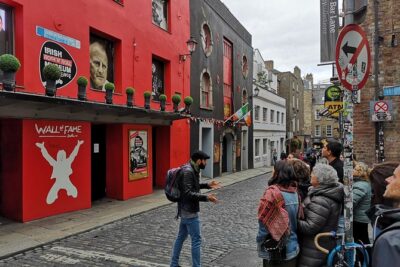
The most useful thing about this Dublin walk is that it puts the 1916 Rising on the actual streets where it happened. You begin at the International Bar with a short lesson on the Great Hunger, Irish politics, and the road to rebellion, then move through the city to buildings and monuments tied to Easter Week and the Irish Civil War.
I like the way the tour connects large political events to small physical clues, such as bullet holes in Daniel O’Connell’s monument. I also like the guides’ personal delivery. Lorcan Collins leads the experience, and guides including Phelim, Liz, Donal, Adam, Phil, and Fallon have been praised for clear speaking, humor, poetry, and songs.
The main drawback is timing. It is sold as roughly two hours, but a full group and a lively question period can stretch the walk closer to three hours. Groups can reach 30 people, so you may need to move close to the guide to hear every word.
Key points to know before you book

- Begin at the International Bar: Arrive early if you want a drink and time to read the guide’s introductory material.
- See the GPO as the central stop: The tour spends about 30 minutes here, where Pádraig Pearse read the Proclamation.
- Expect more than a basic city walk: The opening covers the Great Hunger, the 1916 Rising, the War of Independence, and the Civil War.
- Guides use songs and storytelling: Phelim, Phil, and others may bring poetry or rebel songs into the talk.
- Plan for extra time: The advertised duration is about two hours, but the walk can run longer.
- Pay $27.81 for a history-focused experience: Drinks cost extra, but admission to the outdoor sights is included.
Why the 1916 Rising makes a good walking tour
The Easter Rising can feel confusing when reduced to names and dates. James Connolly, Pádraig Pearse, the Irish Citizen Army, the GPO, the British administration, the War of Independence, and the Civil War all belong to connected but different chapters.
This tour helps you sort them out while you walk. You hear about the Great Hunger of the 1840s first, then the social and political pressures that led toward revolution. That opening matters because the 1916 Rising did not appear out of nowhere. It grew from long arguments about British rule, Irish identity, workers’ rights, and the future of the island.
I like this approach for first-time visitors because you do not need to arrive with a pile of background reading. If you already know the story, you can ask sharper questions and follow the arguments at a finer level.
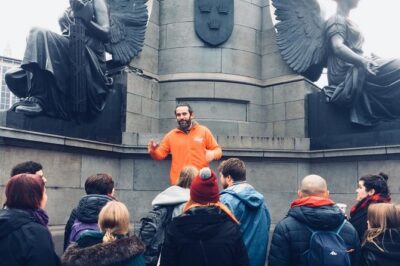
The format also gives the history a physical shape. You are not simply told that a building mattered. You see the place, look at its position in the city, and hear how it fitted into the fighting. At the O’Connell Monument, for example, bullet holes help you picture the conflict in a way that a museum label cannot.
More Walking Tours in Dublin
- Dublin Highlights and Hidden Gems Guided Walking Tour
★ 5.0 · 6,020 reviews - Dublin: Highlights and Hidden Gems Walking Tour
★ 4.9 · 2,140 reviews - 90 Minute Dublin Walking tour and Sightseeing tips
★ 5.0 · 916 reviews
Starting at the International Bar on Wicklow Street
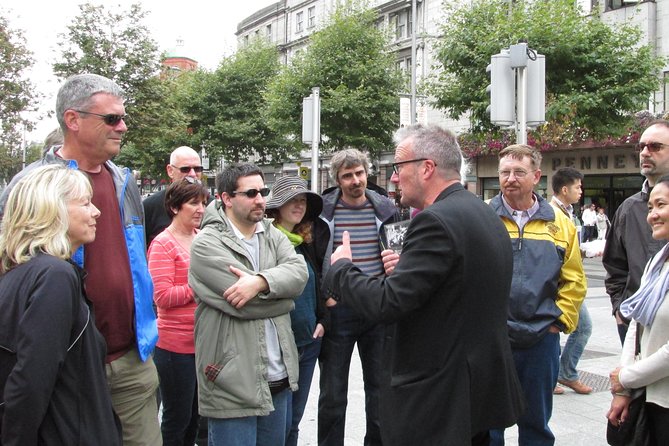
The meeting point is the International Bar at 23 Wicklow Street, in central Dublin. This is more than a place to gather. It sets the tone for the walk, since the tour has been associated with Lorcan Collins since 1996.
You can arrive early for a drink and a look at introductory material supplied by the guide. Alcohol is not included in the $27.81 price, so treat the bar stop as an optional extra rather than part of the ticket.
The introduction is one of the strongest parts of the experience. The guide explains the period from the Great Hunger through the revolutionary years and gives you a chance to ask questions before setting off. That makes the later stops easier to follow, particularly if Irish political history is new to you.
This is also where the guide explains the day’s route. The walk changes from one outing to another, so the exact order and selection of stops can vary. That keeps the experience from feeling mechanically repeated, but it means you should not expect every listed location on every single outing.
City Hall and Dublin Castle: power in the city center
At City Hall, the guide explains how the Irish Citizen Army occupied the building during the 1916 Rising. It is a short stop, about 15 minutes, but it introduces the working-class and organized labor side of the rebellion.
That perspective is important because the Rising was not only a story of poets and nationalist politicians. The Irish Citizen Army and figures such as James Connolly brought workers’ rights and social change into the revolutionary program.
The walk then continues to Dublin Castle, the center of British administration in Ireland. Here, you hear about the castle’s place in the Rising and the War of Independence. If you have seen the film about Michael Collins, the location may feel familiar, but the guide gives it a wider setting within Irish political history.
Do not expect a long interior visit at either stop. The value is in the explanation of how authority operated in Dublin and how the revolutionaries challenged it. You are looking at the buildings from the city streets, not taking a formal castle tour.
The Four Courts and the road toward civil war
The Four Courts offers a useful bridge between the 1916 Rising and the later Irish Civil War. The revolutionaries occupied it in 1916, and it became important again during the fighting that began in 1922.
The building is best viewed from a bridge over the River Liffey rather than approached directly. From there, the guide explains its military and political role and outlines the difficult split among former allies after independence.
This is one of the places where the tour goes beyond a simple account of the Rising. Many short Dublin history walks stop in 1916. This one keeps going into 1922, showing that independence did not end political conflict.
The Four Courts section may be especially useful if you know the broad outline of Irish independence but have never understood the Civil War. The guide’s job here is to make the sequence clear without burying you in dates.
More walking routes in Dublin:
- 2-Hour Historical Walking Tour from Dublin
★ 5.0 · 875 reviews - Historical 2-Hour Guided Walking Tour of Dublin
★ 4.7 · 865 reviews - Dublin Traditional Irish 3 Course Meal Walking Tour with Local
★ 5.0 · 755 reviews - Dublin: Mythology, Folklore and Legends Walking Tour
★ 4.9 · 703 reviews
O’Connell’s bullet holes and the shape of Easter Week
At the monument to Daniel O’Connell, you see bullet holes left from the Rising. They are small details, but they give the city a physical record of the fighting.
The guide uses the monument to explain where British forces and Irish rebels were positioned in 1916. This helps you read the streets as part of a battle plan rather than as ordinary sightseeing stops.
Daniel O’Connell himself belongs to an earlier phase of Irish political life, so this stop also allows the guide to connect different generations of Irish resistance. The walk is strongest when it does this, showing that 1916 was part of a long argument rather than an isolated event.
You should expect to spend around 15 minutes here. The talk can last longer if questions develop, which is another reason to leave room in your schedule.
Jim Larkin and the workers behind the rebellion
The statue of Jim Larkin adds another human and social layer. Larkin was a union leader from Liverpool who became an important figure in Dublin’s labor movement and a close ally of James Connolly.
The guide explains Larkin’s contribution to the revolutionary period and his relationship with Dublin’s working class. This is a welcome counterweight to a version of Irish history that focuses only on military leaders and political speeches.
I find this stop valuable because it shows how the Rising grew from a city with sharp social divisions. The story involves national independence, but also poverty, labor organization, and the rights of ordinary people.
Again, the stop is short, roughly 15 minutes. The statue itself is easy to see, while the real content comes from the guide’s explanation and the links drawn between Larkin, Connolly, and the Citizen Army.
The General Post Office, the tour’s central lesson
The General Post Office is the heart of the walk. The revolutionary forces used it as their headquarters, and Pádraig Pearse read the Proclamation here in 1916.
You spend about 30 minutes at the GPO, longer than at most other stops. That extra time is justified. The guide explains what happened during Easter Week, why the building became such a powerful national symbol, and how the events shaped Ireland’s political future.
The GPO is also the place where the tour’s earlier discussions come together. The opening background, the Citizen Army, British administration, military positions, and the personalities of the rebellion all lead toward this building.
Guides may add poetry or sing a few old rebel songs here or elsewhere along the route. That style will not suit everyone, but it can make the period easier to grasp. The songs show how the Rising entered popular memory, while the stories keep the discussion from becoming a list of names.
The GPO is still an active city building, so this is primarily an exterior history stop rather than a guaranteed extended indoor visit. You come for the setting and the explanation of what happened there.
Moore Street and the final stand
Depending on the day’s route and available time, the walk may continue to Moore Street. This is associated with the final stand of the GPO garrison during Easter Week.
The stop helps complete the military story. You have heard about the GPO as headquarters, and here you learn more about how the garrison’s position deteriorated and how the fighting ended.
Because Moore Street is not guaranteed on every route, I would not book the tour solely for this location. Think of it as a valuable addition when time and routing allow.
The Old Parliament and Trinity College
The Bank of Ireland, often called the Old Parliament, may also appear depending on the route. The guide discusses the building’s role in Irish history and its relationship to neighboring Trinity College.
This stop broadens the walk beyond the immediate sites of the Rising. It places the revolutionary story beside older institutions connected with government, education, and political power.
The route changes by day, so the precise combination of locations is not fixed. That flexibility can work in your favor if you enjoy a guide responding to the group and the city rather than following a rigid script. It also means you should ask at the beginning what stops are planned.
How the guides bring the history to life
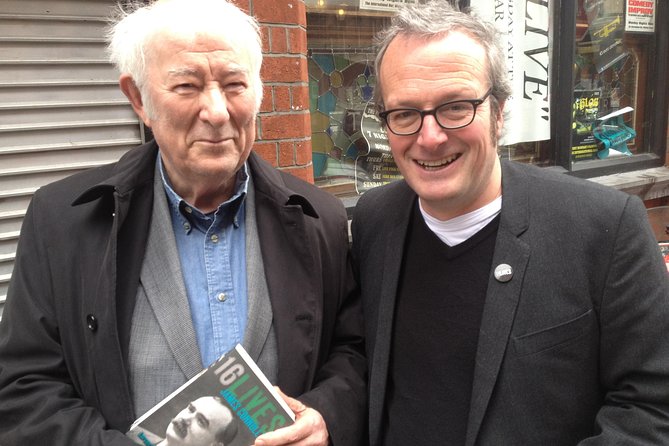
The strongest feature of this experience is the delivery. Lorcan Collins is closely associated with the tour, and other guides named in the feedback include Phelim, Liz, Donal, Adam, Phil, and Fallon.
The common thread is clear speech, strong command of the subject, and a willingness to answer questions. Several guides use humor at suitable moments, which matters during a serious account of imprisonment, violence, and political failure.
Phelim and Phil have been noted for singing, while other guides use poetry and personal storytelling. One guide placed special attention on the role of women in Irish social history, which is useful because women’s work during the revolutionary period can receive less attention in basic sightseeing tours.
I would choose this walk if you enjoy a guide who treats history as a conversation. It is not a silent stroll from one photo stop to another. You may hear stories, ask questions, and get different emphasis depending on the person leading the group.
Price, group size, and practical comfort
At $27.81 per person, the tour is a fair buy for anyone who wants a serious introduction to Ireland’s revolutionary period. There are no separate admission charges for the listed outdoor stops, and the professional guide supplies the main value.
The limit is the group size. Up to 30 people can join, and a large group may make it harder to hear in noisy streets. Stay near the guide, especially at the GPO and along busy central roads.
Most people can participate, and the route is near public transportation. Children must be accompanied by an adult. Since it is an outdoor walking activity, poor weather can lead to a new date or a full refund.
Allow more than two hours in your schedule. The advertised duration is approximately two hours, but an engaged guide, questions, and a group of nearly 30 can push the walk toward three hours.
Who should book this Dublin history walk?
You should book it if you want more than a quick introduction to Dublin’s famous buildings. It suits history buffs, first-time visitors, students of Irish politics, and anyone curious about how the Rising connects to the Great Hunger, labor movements, the War of Independence, and the Civil War.
It is also a good choice if you learn best by seeing places rather than reading museum panels. The bullet holes, the GPO, the Four Courts, and the changing positions around the city give you fixed points for a complicated story.
I would skip it if you want a short, relaxed orientation with little political detail. The subject is serious, the information comes quickly, and the route may last longer than advertised. A large group can also reduce the intimacy of the experience.
Should you book the 1916 Rebellion Walking Tour?
Book this tour if the history of modern Ireland is one of your reasons for visiting Dublin. For $27.81, you get a clear route through the city, a detailed explanation of the Rising, and a guide who may add songs, poetry, humor, and personal insight.
The best reason to go is the combination of place and story. You do not simply hear that the GPO mattered. You stand outside it, learn about Pearse’s Proclamation, connect it to the other occupied buildings, and follow the story into the War of Independence and Civil War.
Just plan for a possible three-hour outing, arrive ready to walk, and stand close enough to hear. If that sounds worthwhile, this is one of the more useful ways to make sense of Dublin’s revolutionary past.
FAQ
Where does the 1916 Rebellion Walking Tour start?
The tour starts at the International Bar, located at 23 Wicklow Street, Dublin, D02 VH59, Ireland.
Where does the tour finish?
The activity ends back at the meeting point.
How long does the tour last?
The stated duration is approximately two hours. The walk can take longer, particularly with a large group and questions.
What places does the tour visit?
Possible stops include City Hall, Dublin Castle, the Four Courts, the O’Connell Monument, the Jim Larkin Statue, the General Post Office, Moore Street, and the Bank of Ireland, also known as the Old Parliament. The route can vary.
Are drinks included in the price?
No. Alcoholic drinks are available to purchase, but they are not included.
Is prior knowledge of Irish history required?
No. The guide begins with background on the Great Hunger and the events leading to the 1916 Rising, so you can join without prior study.
What happens if the weather is poor?
The experience requires good weather. If it is canceled because of poor weather, you will be offered a different date or a full refund.
Just added around Dublin
- Gin School, distill you own gin, cocktails, tastings, food★ 5.0 · 8 reviews
- Dublin : Street Art Walking Tour★ 5.0 · 3 reviews
- Dublin: Personal Photographer- Travel Photography Experience★ 4.5 · 8 reviews
- Dublin: Skip-the-line Book of Kells & Old Town Private Tour★ 5.0 · 6 reviews
- Dublin: Howth Coastal Craft Beer and Seafood Tour★ 5.0 · 62 reviews
- Vikings In Dublin (Walking Tour)★ 5.0 · 8 reviews
- Dublin: Silent Disco Walking Tour★ 4.9 · 21 reviews
- Dublin: Private Tour of City Monuments in Spanish★ 5.0 · 6 reviews
Walking Tours, compared.
Dublin Highlights and Hidden Gems Guided Walking Tour
Read our review →
90 Minute Dublin Walking tour and Sightseeing tips
Read our review →

Dublin Traditional Irish 3 Course Meal Walking Tour with Local
Read our review →
Browse the lists this tour appears in