
Reviewed · WALKING TOURS
Small Group Bucket List Sights Walking Tour with a Local Guide
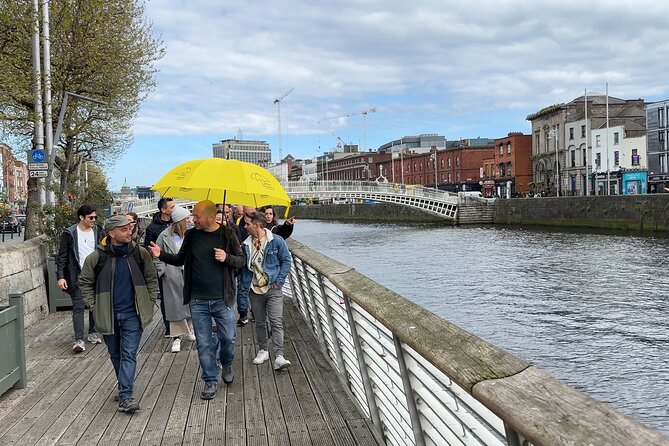
Dublin’s best-known sights fit into a surprisingly compact walk. This two-hour route links Christ Church Cathedral, Dublin Castle, Temple Bar, the Liffey bridges, and Trinity College, giving you a useful first look at the city without spending the morning inside one attraction.
I like the clear route and the personal guiding. Peter is often praised for answering questions and offering practical ideas for the rest of your stay, while Patrick, Martin, and Rob have also led this walk. I also like the price: at $20.52, you are paying for a guided orientation rather than a costly attraction package.
The main tradeoff is simple: you stop at 12 places, but you do not go inside most of them. Ten minutes at each stop means a brisk pace and plenty of useful context, but not a detailed visit to the cathedrals, castle, Chester Beatty Library, or Book of Kells exhibition.
Key points to know before booking
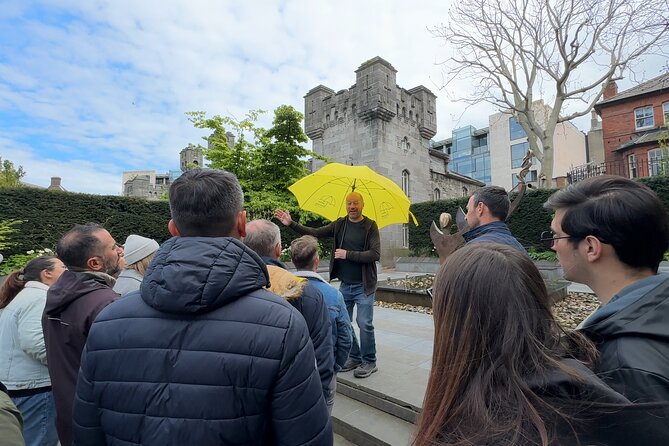
- Twelve central Dublin sights in two hours: The route covers the city’s main historic core, from Christ Church to Trinity College.
- A local guide makes the difference: Peter, Patrick, Martin, and Rob are named guides associated with the experience, and the strongest praise centers on clear explanations, energy, and helpful suggestions.
- Mostly an exterior tour: Admission is not included at Christ Church Cathedral, St. Patrick’s Cathedral, Dublin Castle, and Trinity College.
- Small group, but not always tiny: The maximum is 25 people, although some departures may have only a few participants.
- Useful for your first day: The walk helps you locate major sights and choose which ones deserve a longer visit later.
- Easy logistics: It starts at 10:00 am near Wood Quay and finishes outside Trinity College on College Green.
A smart first walk through Dublin’s old center
This is an orientation walk rather than a museum tour. You move through the old city, hear how Dublin developed, and get enough background to make better choices for the rest of your visit.
The route also gives you a feel for Dublin’s changing character. You pass medieval religious buildings, former centers of British rule, Georgian civic architecture, lively pub streets, modern offices, and the river crossings that tie the city together.
I find that approach useful in Dublin because the key sights are close together, but their stories can feel disconnected when you visit them alone. A guide can connect Viking Dublin, Norman building, British administration, Irish independence, modern redevelopment, and local legends in one continuous walk.
The guides appear to keep the tone conversational. Peter, in particular, is praised for encouraging questions rather than simply reciting facts. That matters on a short tour, since you can ask about something you noticed instead of waiting for a formal lecture to end.
More Walking Tours in Dublin
- Dublin Highlights and Hidden Gems Guided Walking Tour
★ 5.0 · 6,020 reviews - Dublin: Highlights and Hidden Gems Walking Tour
★ 4.9 · 2,140 reviews - 1916 Rebellion Walking Tour
★ 5.0 · 1,605 reviews
Christ Church Cathedral and the medieval starting point
The tour begins at 121 R137 in the Wood Quay area, close to Christ Church Cathedral. Starting here puts you in one of Dublin’s oldest parts and gives the guide a strong opening point for the city’s early story.
Christ Church began as a wooden Viking church before the Normans rebuilt it in stone. The building was later renovated in the 19th century with money from the whiskey trade. That sequence gives you a quick lesson in Dublin itself: Viking foundations, Norman power, and later commercial wealth all left their mark.
You get about ten minutes here. The cathedral’s interior is not included, so you should think of this stop as an introduction and photo opportunity, not a substitute for an admission visit.
If you plan to return inside later, the guide’s explanation can help you notice the building in context. If your schedule allows only one cathedral interior, you may want to compare Christ Church with St. Patrick’s before deciding.
St. Patrick’s Cathedral and Dublin’s patron saint
The next cathedral stop is St. Patrick’s, associated with Ireland’s best-known patron saint. The guide explains the familiar story of St. Patrick driving the snakes from Ireland, while also placing the cathedral in the wider development of the city.
The building received major renovation in the 1860s through the Guinness family, particularly Sir Benjamin Lee Guinness. That detail adds a useful reminder that Dublin’s landmarks were not preserved by age alone. Wealthy families and private money played a major role in keeping important buildings standing.
Again, you have about ten minutes outside. Admission is not included, and the tour does not give you time to study the cathedral’s interior. I would treat this as a decision point: use the walk to learn which sites interest you, then return independently if you want a fuller visit.
Dubh Linn Gardens and the Viking harbor story
Dubh Linn Gardens offers a quieter pause after the two cathedral stops. The garden is home to the Chester Beatty Library and is described as the area where Vikings moored their longboats when they arrived in Dublin in the ninth century.
The stop is free, and the garden provides a change of pace from streets and traffic. It also helps explain the name Dublin, connected to the dark pool, or Dubh Linn, that gave the city its name.
You spend roughly ten minutes here. Do not expect a long visit to the Chester Beatty Library as part of this experience. The garden is the focus of the stop, while the nearby library is something you can consider for another part of your day.
This is one of the more useful locations for understanding that Dublin was not simply built around later Georgian streets. Its story reaches back to a Viking settlement and the water routes that made the site useful.
More walking routes in Dublin:
- 90 Minute Dublin Walking tour and Sightseeing tips
★ 5.0 · 916 reviews - 2-Hour Historical Walking Tour from Dublin
★ 5.0 · 875 reviews - Historical 2-Hour Guided Walking Tour of Dublin
★ 4.7 · 865 reviews - Dublin Traditional Irish 3 Course Meal Walking Tour with Local
★ 5.0 · 755 reviews
Dublin Castle and the long period of British rule
Dublin Castle brings the political story into view. It served as the center of British government in Ireland for 700 years, and its buildings show several periods at once: medieval, Georgian, Gothic, and modern.
That mix makes the castle an important stop even if you only see it from outside. The guide can explain why the complex does not look like one single, uniform fortress. Its appearance reflects changing needs, changing rulers, and repeated rebuilding.
The ten-minute stop is not enough for the castle’s interior. Admission is not included, so plan a separate visit if you want to explore the State Apartments or other rooms. The walk’s value here is the setting and the political background, not a full castle tour.
I especially like this part of the route for visitors who want more than a list of old buildings. The guide links the castle to Ireland’s political past, then continues toward places that explain the country’s later national identity.
City Hall and the meaning of the Irish flag
Near City Hall and the front gate of Dublin Castle, the guide discusses the significance of Ireland’s national flag. The explanation centers on peace between Catholic and Protestant communities and on the relationship between north and south.
This is a short stop, but it gives the walk a clear human and political thread. Instead of treating the flag as a simple national symbol, you get a sense of the tensions it was meant to represent and bridge.
City Hall also adds a civic layer to the route. You are still near the castle and the old seat of British rule, but now the focus turns toward Irish public life and national identity.
The stop is free. Since this is an outdoor explanation, it works best if you are willing to listen closely and ask questions. The reviews repeatedly point to the guides’ willingness to explain difficult subjects and respond to individual questions, which is especially useful here.
Temple Bar beyond the pub signs
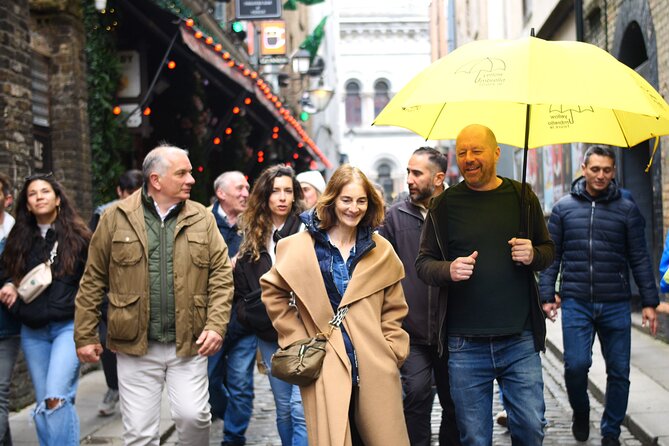
Temple Bar is one of Dublin’s most famous areas, known for pubs, evening activity, and tourist attention. The guide also explains how this old part of the city was laid out during the Tudor conquest of Ireland.
That background gives you a better way to read the district. Temple Bar is not only a collection of colorful pubs. Its streets belong to an older part of Dublin, and the area’s present-day reputation sits on top of earlier urban and political changes.
You spend about ten minutes here. The tour does not include food, drinks, or nightlife entry, so you can return later if you want to explore the pubs at your own pace.
This stop may feel crowded or noisy at certain times, especially compared with Dubh Linn Gardens. That contrast is part of the route’s appeal, but it also means you should stay close enough to hear the guide. A small group helps, though the maximum group size is 25.
Crossing the Liffey on Millennium Bridge
The walk then crosses the River Liffey via Millennium Bridge. From here, the guide uses the river and the city skyline to connect very old Dublin with very new Dublin.
The view takes in the direction where the Celts established a settlement thousands of years ago and the modern Silicon Docks, shaped in part by American influence. In a few minutes, you get a broad view of Dublin’s growth from early settlement to a modern business center.
This is a good point to pause and look around rather than focus only on the next stop. Bridges make useful orientation points because the river divides the city into north and south, while the surrounding streets reveal how the city expanded.
The stop lasts about ten minutes. There is no attraction admission involved. You are simply using the bridge as a viewpoint and as part of the route across the city.
Ha’penny Bridge and the return south
The Ha’penny Bridge brings you back across the Liffey. Its name comes from the half-penny toll once charged to cross it, and it remains one of Dublin’s most recognizable crossings.
The guide also explains that the bridge was originally named for the Duke of Wellington. The structure’s later connection with Harland & Wolff adds another practical detail: the bridge no longer shakes as people walk across it.
This is a short, visual stop with a clear sense of place. You get river views, a landmark photograph, and another chance to understand how Dublin’s two sides connect.
The bridge can be busy, and the walking surface is shared with other people, so you should expect to keep moving rather than linger in the middle. The tour does not charge an additional admission fee here.
Merchant’s Arch and Dublin’s sharp contrasts
At Merchant’s Arch, the guide points out the contrast between Crown Alley, the arch itself, and Sam Stephenson’s brutalist Stephenson Tower. It is a compact lesson in how Dublin’s architecture changes from older commercial streets to modern concrete offices.
This stop may appeal to you if you enjoy cities as living places rather than collections of preserved monuments. The route does not pretend Dublin belongs to one period. Instead, it shows old lanes, newer buildings, tourist streets, and working city spaces side by side.
The stop takes about ten minutes. You are still near Temple Bar, but the focus shifts from nightlife to architecture and urban change.
College Green and the road to Trinity College
College Green is one of the city’s most impressive civic spaces, with notable bank and parliamentary buildings around it. It once served as a center of government and finance for a city that saw itself as the second city of the empire.
That detail helps explain the scale and confidence of the buildings. Dublin was not a minor provincial town in its own eyes. Its institutions, wealth, and political role shaped the grand spaces you see here.
The stop is free and takes about ten minutes. This is also where the walk starts to prepare you for its final destination, Trinity College.
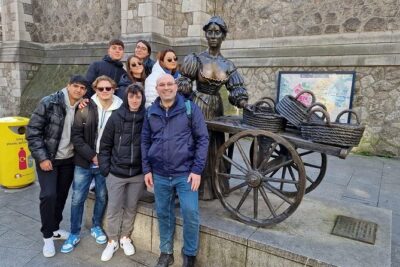
Molly Malone and a familiar Dublin character
The Molly Malone statue provides the tour’s lighter moment. No first visit to central Dublin feels quite complete without stopping to say hello to this famous figure.
The statue is tied to the popular song about Molly Malone, and it has become one of the city’s best-known meeting points. You should expect a quick stop rather than a long historical lecture.
It is a useful reminder that Dublin’s identity includes music, storytelling, and public characters as well as churches and government buildings. The stop is not a major architectural visit, but it gives the route some warmth before the final college setting.
Trinity College and the end at College Green
The tour ends outside Trinity College, at Fox House, 37 College Green, Dublin 2, near the front gate. Trinity is home to the famous Book of Kells exhibition, but admission is not included in the walking tour.
That arrangement works well for planning. The guide can finish by pointing out the college and explaining why it matters, then you can decide if you want to enter immediately or return later. The tour gives you a useful introduction without forcing you to pay for an attraction you may not have time to visit.
The end point is practical, too. You are near central streets and other major sights, and the guide can offer suggestions for what to do next. Several strong comments about the experience focus on these follow-up ideas, including museums and walks that fit different interests.
What $20.52 buys you
At $20.52 per person, this is a modest outlay for two hours with a local English-speaking guide. The value comes from context, route planning, and the chance to ask questions, not from included admissions or refreshments.
If you entered every major site along the way, the morning would cost more and take much longer. This tour lets you inspect the exteriors first and choose where to spend your money afterward.
The price is strongest for a first visit, a short city break, or anyone who wants to get oriented before exploring alone. It is less useful if you already know central Dublin well or if your main goal is to spend time inside the cathedral, castle, or Book of Kells exhibition.
Pace, group size, and practical fit
The advertised duration is about two hours, with ten minutes assigned to each of the 12 stops. That tells you what to expect: a steady walk, short explanations, and little time for extended photography or independent browsing.
The maximum group size is 25. That is still small enough for a guide-led walk, but it is not a private tour. Some departures may be much smaller, including occasions with only two people, which can make the question-and-answer side more personal.
The meeting time is 10:00 am. You should arrive ready to walk and wear sensible shoes. The route uses city streets, bridges, and public spaces, and most people can participate. Service animals are allowed, and the start and finish are near public transportation.
The tour is offered in English and uses a mobile ticket. Free cancellation is available up to 24 hours before the start time. After that cutoff, the amount paid is not refunded, and changes are not accepted.
Who should book this Dublin walk
I would choose this tour for a first morning in Dublin, especially if you want to understand the central area before visiting individual attractions. It suits solo visitors, couples, families with older children, and anyone on a short break who needs a clear route through the old city.
It is also a good fit if you enjoy asking questions. Peter’s style, as described through the experience, includes personal conversation, practical suggestions, and explanations beyond fixed facts. Patrick, Martin, and Rob are also named guides, so the exact tone may vary by departure.
You may want a different tour if you need step-by-step access inside every landmark, a private group, or a slow architectural study. This is a brisk overview, not a full day of interiors.
Should you book it?
Book it if you want a friendly introduction to Dublin’s historic center, practical ideas for the rest of your visit, and a route that covers the essential sights for a low price.
Skip it if you already know the city or want long visits inside Christ Church, St. Patrick’s Cathedral, Dublin Castle, or Trinity College. For most first-time visitors, though, the combination of strong local guiding, useful orientation, and a $20.52 price makes this a sensible way to begin.
FAQ
Where does the tour start?
It starts at 121 R137 in Wood Quay, Dublin, near Christ Church Cathedral.
Where does the tour finish?
The tour finishes at Fox House, 37 College Green, Dublin 2, outside the front gate of Trinity College.
What time does the tour begin?
The scheduled start time is 10:00 am.
How long does the walking tour last?
The experience lasts approximately two hours.
Are admission tickets to the attractions included?
No. Admission is not included for Christ Church Cathedral, St. Patrick’s Cathedral, Dublin Castle, Trinity College, and several other listed stops. Dubh Linn Gardens, City Hall, Temple Bar, College Green, and other public areas are free to visit.
How large can the group be?
The maximum group size is 25 people.
Can I cancel for a full refund?
Yes. You can cancel at least 24 hours before the experience start time for a full refund. Cancellations or changes made less than 24 hours before the start time are not accepted for a refund.
Just added around Dublin
- Wicklow Mountains Private Day Tour including Glendalough★ 5.0 · 7 reviews
- Wicklow: Private Day Tour from Dublin★ 5.0 · 5 reviews
- Women Of Ireland: Trailblazers & Pioneers★ 5.0 · 4 reviews
- Premium Irish Whiskey Tasting Hosted by Local Dublin Expert★ 5.0 · 77 reviews
- Whiskey Tasting Tour of Dublin★ 5.0 · 117 reviews
- Wicklow Mountains & Glendalough Luxury Private Day Tour★ 5.0 · 23 reviews
- Wicklow tour of Glendalough★ 4.5 · 8 reviews
- Semi-Private (8people max) 2.5 Hr Dublin Walking Tour★ 5.0 · 69 reviews
Walking Tours, compared.
Dublin Highlights and Hidden Gems Guided Walking Tour
Read our review →

90 Minute Dublin Walking tour and Sightseeing tips
Read our review →

Dublin Traditional Irish 3 Course Meal Walking Tour with Local
Read our review →
Browse the lists this tour appears in