
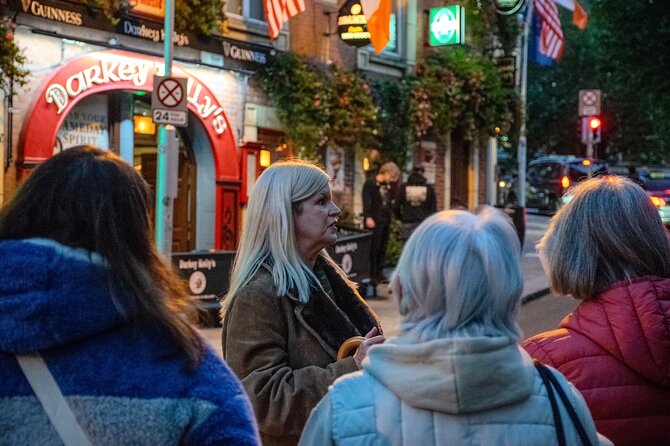
Reviewed · WALKING TOURS
Haunted Dublin Walking Tour
Dublin’s darker past comes alive on this evening walk, where stories of ghosts, grave robbing, witchcraft, and violent old neighborhoods unfold beside some of the city’s best-known buildings. The route runs from Temple Bar to St Stephen’s Green, giving you a useful city walk along with the chills.
I like the mix of real history and folklore, and I like that the guides, including Ciarán, Deirdre, Lee, and Ross, bring different humor and storytelling styles to the evening. The main drawback is the pace: this is a two-hour walk across central Dublin, and some guides move quickly. Wear comfortable shoes.
Key points
- Bram Stoker connection: Learn about the future Dracula author’s connection with Dublin Castle and the world of gothic horror.
- Ten central Dublin stops: The route links Temple Bar, Dublin Castle, theatres, cathedrals, Marsh’s Library, St Kevin’s Park, and St Stephen’s Green.
- More historical than theatrical: Expect storytelling about real people, crime, religion, and folklore rather than actors or staged scares.
- A brisk evening walk: The route covers a good stretch of the city center, with no snacks or attraction admissions included.
- Strong guide-led experience: Ciarán, Deirdre, Lee, and Ross are praised for humor, storytelling, local knowledge, and the ability to adapt.
- Good value at $29.02: You get about two hours with a nationally accredited guide and a different view of Dublin’s familiar streets.
Dublin’s dark side begins in Temple Bar
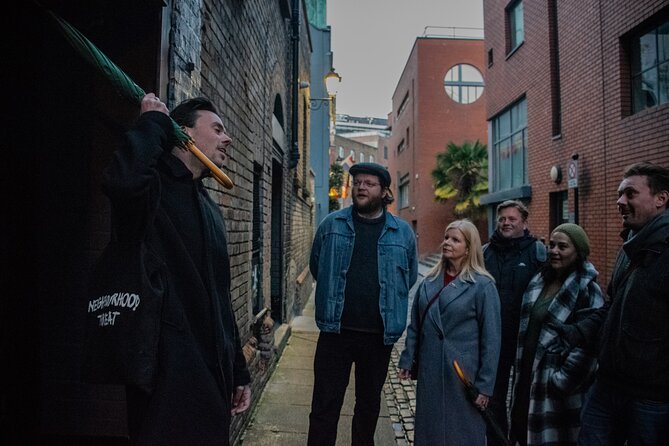
The tour starts at 6:00 p.m. on Crown Alley in Temple Bar, right in the middle of Dublin’s best-known nightlife quarter. This is a convenient meeting point, but it can feel busy, so give yourself enough time to find the exact starting place.
Temple Bar is more than pubs and cobbled lanes. It provides a fitting opening for a walk about old Dublin, where lively streets often sit above layers of crime, poverty, religion, and folklore. Your guide sets the tone here, explaining that the evening will blend documented events with stories that have gathered supernatural detail over time.
That distinction matters. This is not a haunted-house attraction, and you should not expect special effects or actors jumping from doorways. The appeal is the storytelling, with the city itself serving as the setting.
More Walking Tours in Dublin
- Dublin Highlights and Hidden Gems Guided Walking Tour
★ 5.0 · 6,020 reviews - Dublin: Highlights and Hidden Gems Walking Tour
★ 4.9 · 2,140 reviews - 1916 Rebellion Walking Tour
★ 5.0 · 1,605 reviews
Dublin Castle and the Bram Stoker connection
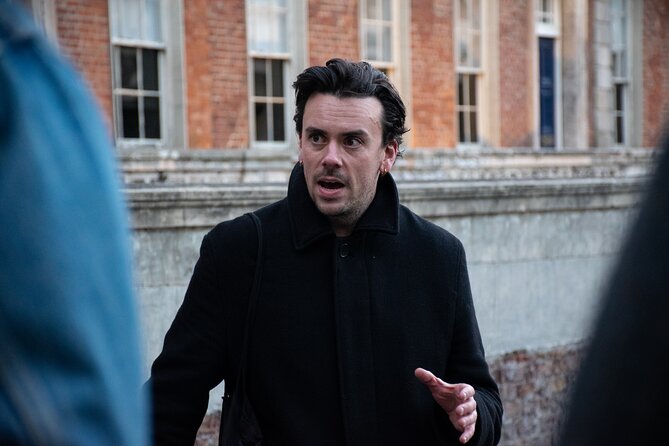
Dublin Castle is one of the most important stops. For centuries, it represented imperial rule in Ireland, making it a powerful backdrop for stories about authority, fear, punishment, and rebellion.
The stop also connects the city with Bram Stoker, one of the great names in gothic horror. Stoker worked in Dublin Castle before becoming famous for Dracula, and the tour uses that link to place his writing in a real local setting. You get more than a quick mention of the author. The guide connects Dublin’s institutions, old tales, and darker themes with the imagination that later shaped his fiction.
The tour does not include admission to the castle. You should think of this as an outdoor stop and a story-based visit, not a castle tour. That is important because access can also be affected by closures or special events. One booking was disrupted when the castle was closed during New Year celebrations, though the guide adapted the route.
Allow about 15 minutes here. That is enough time for context and storytelling, but not for a full look inside the complex.
Theatres where old stories still echo
The route continues to the 3Olympia Theatre, a Victorian music hall and long-standing concert venue. The theatre adds a different kind of atmosphere to the walk. Instead of focusing only on murder or ghosts, the story here draws on performance, crowds, entertainers, and the strange energy that gathers around old public venues.
Next comes Smock Alley Theatre 1662, identified as Ireland’s oldest theatre. This is another useful change of pace. Theatre buildings naturally invite tales of performers, backstage drama, and uneasy legends, but the value here is also historical. You are seeing how Dublin’s entertainment districts developed and how old buildings became part of the city’s folklore.
These two stops help keep the walk from becoming a string of similar ghost stories. You move between public entertainment, political power, religion, and old streets. I find that variety makes the two hours easier to follow and gives the tour a clearer picture of Dublin beyond its famous pubs.
Christ Church and the old neighborhood called Hell
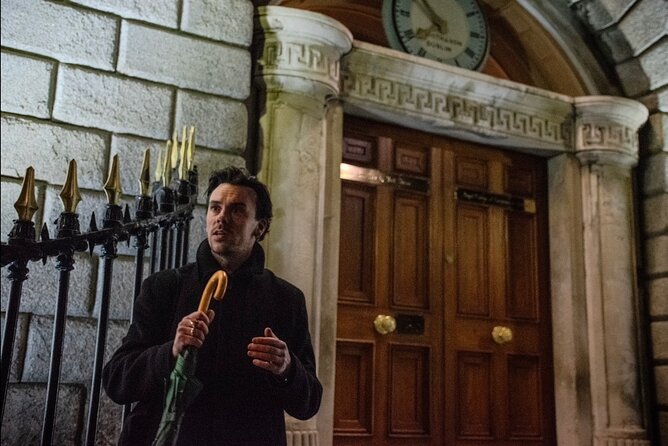
Christ Church Cathedral brings the tour into one of Dublin’s most atmospheric areas. The cathedral itself is a major landmark, but the story here turns to the streets that once surrounded it.
In the shadow of the cathedral was a rough district known locally as Hell. It was associated with brothels, drinking houses, and the rich and powerful who sought entertainment there. The guide introduces some of the people connected with this old quarter, including figures whose ghostly presence is still said to linger nearby.
This is one of the strongest stops for understanding how Dublin’s past was not tidy or polite. Sacred buildings and disreputable streets stood close together. Wealth, poverty, religion, vice, and violence shared the same small area.
The material can be grim, but it is not presented as nonstop gore. The tone depends on the guide. Ciarán is praised for mixing humor with gruesome facts, while Deirdre has been especially effective at turning local characters into memorable stories. You may hear more historical detail than actual supernatural evidence, which is part of the tour’s appeal and also its limitation.
More walking routes in Dublin:
- 90 Minute Dublin Walking tour and Sightseeing tips
★ 5.0 · 916 reviews - 2-Hour Historical Walking Tour from Dublin
★ 5.0 · 875 reviews - Historical 2-Hour Guided Walking Tour of Dublin
★ 4.7 · 865 reviews - Dublin Traditional Irish 3 Course Meal Walking Tour with Local
★ 5.0 · 755 reviews
St Patrick’s Cathedral, Marsh’s Library, and the Liberties
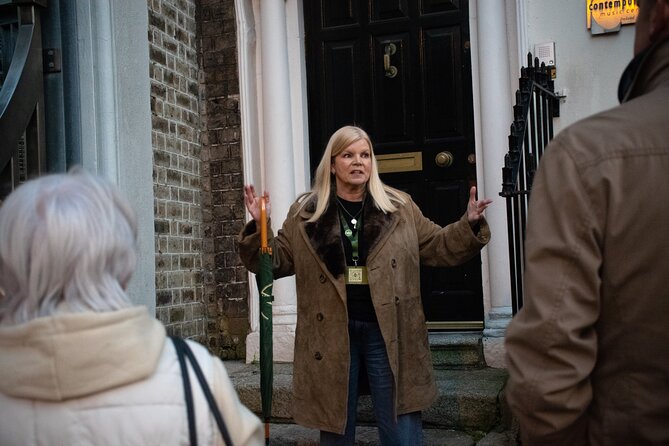
St Patrick’s Cathedral is the next major landmark. Named for Ireland’s patron saint, it provides a natural setting for tales about sinners, punishment, and the darker side of religious Dublin.
The nearby Liberties add social history to the ghost stories. This part of the city has long been linked with working life, crowded streets, drinking, crime, and strong local character. The guide also discusses the notorious Four Corners of Hell, a phrase tied to the area’s old reputation.
Marsh’s Library sits in the cathedral’s shadow and is described as Ireland’s oldest public library. Its old books, narrow spaces, and preserved interior make it a natural place for stories about strange events and uneasy encounters. You do not enter the library as part of this walking tour, so consider the stop an exterior visit with narration.
I like this stretch because it shows how the tour uses famous buildings as anchors. You are not simply told a ghost story in isolation. You learn why a cathedral, library, and old neighborhood mattered, then hear how supernatural tales became attached to them.
St Kevin’s Park and a darker, quieter lane
St Kevin’s Park is a smaller stop, but it may be one of the most atmospheric. The route leads to the ruins of an old church graveyard down a dark lane in the city center.
This is the kind of place where the setting does a lot of the work. The remains, the confined lane, and the evening light create a stronger mood than a busy public square. The guide’s story fills in the gaps, bringing together old burial grounds, forgotten buildings, and the people connected with them.
Do not expect a long stop or a formal cemetery visit. The schedule allows about 10 minutes here. Still, short stops can work well on a walking tour because they keep the route moving and prevent the atmosphere from becoming forced.
The Easter Rising and the Royal College of Surgeons
At the Royal College of Surgeons, the subject shifts from ghosts and old crime to the Easter Rising of 1916. The building was one of the garrisons during the uprising and held a position on the western side of St Stephen’s Green.
This is a valuable reminder that Dublin’s frightening past is not limited to supernatural tales. Political violence, military conflict, and the fight for Irish independence also shaped these streets. The guide places the building within that history before moving toward the park.
For me, this stop broadens the experience. If you are coming only for ghost stories, you still get the darker material. If you want a better sense of Dublin’s past, the Easter Rising connection gives the walk more substance.
Finishing at St Stephen’s Green
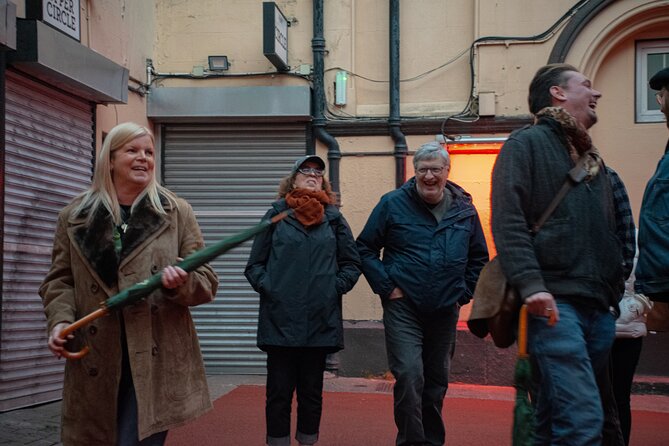
The tour ends at St Stephen’s Green, one of Dublin’s great Georgian squares. After walking through narrow lanes, old theatre districts, cathedral precincts, and former areas of vice, the open park provides a calmer finish.
The end point is practical. St Stephen’s Green sits at the top of Grafton Street, Dublin’s most famous shopping street. You are close to restaurants, pubs, and public transport, so it is easy to continue your evening without a long trip back across town.
The walk covers a good portion of central Dublin. Some people describe the pace as quick, particularly with Deirdre, so do not treat this as a slow photographic stroll. You will have chances to look around, but the guide needs to keep a group together and reach all ten stops in about two hours.
What the guides add to the evening
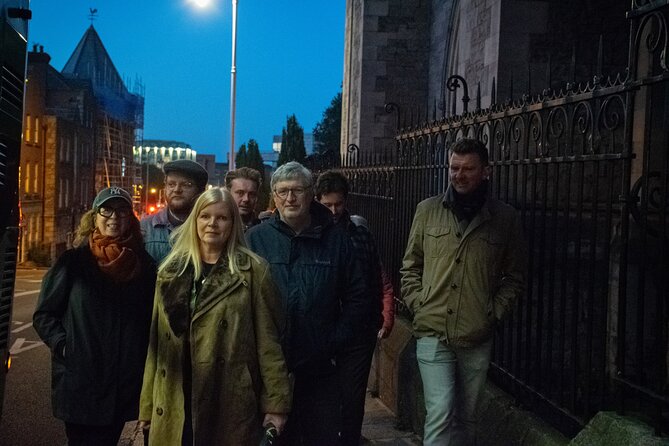
The guide makes or breaks a storytelling tour, and this experience has several recurring names. Ciarán is praised for humor, strong pacing, literary interests, and the ability to combine practical Dublin tips with spooky facts. Deirdre brings energy and a lively way of handling questions, while Lee is noted for adapting when bells, closures, or other city noise interrupt a story. Ross is described as a charming storyteller with a strong grasp of Dublin through the ages.
That variety means the exact feel can change from one evening to another. You may get a more comic performance, a more literary evening, or a stronger focus on local history. The common thread is guide-led storytelling rather than scripted spectacle.
I especially like that the guides can adjust when something unexpected happens. Church bells have interrupted one tour, and Dublin Castle has been closed during a holiday period. A good guide can move the group, change the order, and keep the story alive.
How scary is it, really?
The tour is best described as a dark historical walk with ghost stories, not a fright attraction. You will hear about alleged hauntings, notorious characters, murders, grave robbing, witchcraft, and folklore. You may also hear jokes and practical advice about Dublin.
That balance makes it suitable for adults, older children, history fans, and people who enjoy a little mystery without wanting graphic horror. A teenager can enjoy it, but the material includes crime, violence, and grim historical subjects.
If you want repeated scares, jump effects, or proof of paranormal activity, you may find the experience too mild. If you like stories tied to real streets and buildings, the format works much better.
Is $29.02 a fair price?
At $29.02 per person, the price is reasonable for a two-hour guided walk in central Dublin. You are paying for a nationally accredited guide, a planned route, local storytelling, and the convenience of seeing several districts in one evening.
The value is strongest if this is your first visit. The walk helps you get oriented between Temple Bar, Dublin Castle, Christ Church Cathedral, St Patrick’s Cathedral, and St Stephen’s Green. You also finish near Grafton Street, where you can make your own plans for dinner or a drink.
The value is weaker if you expect entry to Dublin Castle, St Patrick’s Cathedral, Marsh’s Library, or the theatres. No attraction admission is included, and snacks are not provided. This is an outdoor walking experience, not a package of interior visits.
The tour has a maximum of 30 people. That is not a tiny group, but it is manageable for a city walk if the guide keeps the group together. Service animals are allowed, and the tour is near public transport.
Practical advice before you book
Start by wearing shoes you can walk in for two hours. The route is not described as strenuous, but you cover a good distance and may move quickly between stops.
Dublin weather can change, so bring suitable rain protection. One evening remained worthwhile despite rain, but wet streets and an outdoor tour can make the walk less comfortable.
Book ahead if your schedule is fixed. The experience is booked an average of 27 days in advance, which suggests that popular dates can fill before your trip.
The tour is offered in English and begins at 6:00 p.m. That timing gives you Dublin after dark without making the evening too late. The end near Grafton Street also makes it easy to pair the walk with dinner.
Free cancellation is available up to 24 hours before the start time. Changes or cancellations inside that window are not accepted for a refund.
Should you book Haunted Dublin Walking Tour?
Book it if you want to see central Dublin at night while learning about its crime, folklore, literature, and haunted places. It is especially good for first-time visitors, fans of Bram Stoker, history buffs, and anyone who prefers stories tied to real buildings rather than staged scares.
Skip it if you dislike walking, need slow access to each stop, or want to tour the interiors of Dublin Castle and the cathedrals. For most people who enjoy a well-told dark tale, the $29.02 price buys a useful orientation walk with plenty of character.
FAQ
Where does the Haunted Dublin Walking Tour start?
It starts at 3 Crown Alley in Temple Bar, Dublin, at 6:00 p.m.
Where does the tour finish?
The tour finishes at St Stephen’s Green in Dublin 2, near the top of Grafton Street.
How long does the tour last?
The walking tour lasts approximately two hours.
How much does the tour cost?
The listed price is $29.02 per person.
Is the tour offered in English?
Yes. The tour is offered in English.
Is admission to Dublin Castle included?
No. The experience includes a stop at Dublin Castle, but attraction admission is not included.
Are snacks included?
No. Snacks are not included.
How many people can join the tour?
The group can include a maximum of 30 people.
Is the tour physically demanding?
A moderate level of physical fitness is recommended. You should expect a substantial amount of walking, and the pace may be brisk.
Can I cancel for a full refund?
Yes, if you cancel at least 24 hours before the experience starts. Cancellations made less than 24 hours before the start time are not refunded.
Just added around Dublin
- Gin School, distill you own gin, cocktails, tastings, food★ 5.0 · 8 reviews
- Dublin : Street Art Walking Tour★ 5.0 · 3 reviews
- Dublin: Personal Photographer- Travel Photography Experience★ 4.5 · 8 reviews
- Dublin: Skip-the-line Book of Kells & Old Town Private Tour★ 5.0 · 6 reviews
- Dublin: Howth Coastal Craft Beer and Seafood Tour★ 5.0 · 62 reviews
- Vikings In Dublin (Walking Tour)★ 5.0 · 8 reviews
- Dublin: Silent Disco Walking Tour★ 4.9 · 21 reviews
- Dublin: Private Tour of City Monuments in Spanish★ 5.0 · 6 reviews
Walking Tours, compared.
Dublin Highlights and Hidden Gems Guided Walking Tour
Read our review →

90 Minute Dublin Walking tour and Sightseeing tips
Read our review →

Dublin Traditional Irish 3 Course Meal Walking Tour with Local
Read our review →
Browse the lists this tour appears in