
Reviewed · WALKING TOURS
Dublin: Hidden Gem Walking Tour with Local Guide
Tallaght has far more to tell than its modern suburban image suggests. This two-hour walk with local guide Sophie traces the area from ancient monastic Ireland through Irish literature, war reporting, aviation, chocolate making, folklore, and the rapid urban growth of the 1970s and 1980s.
I like the personal scale of this tour, limited to 12 people, and the way it links famous Irish figures to ordinary streets and landmarks. I also like the bilingual touches, including an Irish legend, poetry in Irish and English, and basic Irish phrases at the end. The main drawback is that the route is mostly about stories and context rather than major preserved sights, so it suits curious history lovers more than anyone seeking a classic Dublin postcard walk.
Key points about the Tallaght walking tour
- A local story of change: Follow Tallaght from ancient settlement and monastic importance to one of Ireland’s fastest-growing urban areas in the 1980s.
- Literary connections: Learn about writer Katharine Tynan, her home at Whitehall, and her links with W.B. Yeats and George William Russell.
- Unexpected historical figures: Hear how Tallaght produced William Howard Russell, an early war correspondent who reported from the Crimean War and American Civil War.
- Industry and memory: Explore Tallaght Aerodrome, Urney Chocolates, and Jacob’s, along with their effect on local life.
- Irish language and folklore: Hear Oisín i dTír na nÓg in Irish and English, then learn a few useful Irish phrases.
- Small-group value: At $18.05 per person, the tour offers a focused local introduction at a modest price, with free cancellation up to 24 hours before the start.
Why Tallaght makes an unusual Dublin walk
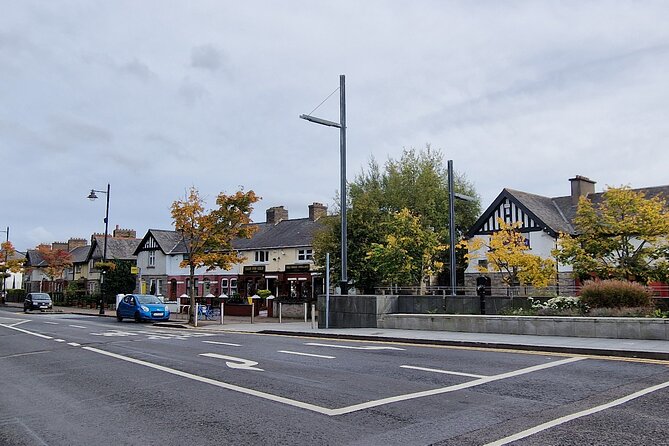
Most first-time Dublin walks stay close to the city centre. This one takes you southwest, beginning in Kingswood Heights and ending in Tallaght Village. That change of setting is the point.
Tallaght can look like a modern outer suburb at first glance, but the route reveals older layers beneath the roads, retail parks, housing, and campus buildings. You move through places tied to monasteries, writers, political unrest, industry, transport, and migration.
I particularly like the tour’s sense of scale. It does not pretend that every stop has a grand monument. Instead, Sophie uses streets, views, plaques, former sites, letters, poems, and photographs to show how a place can matter even after much of its visible past has gone.
The group limit of 12 should help keep the walk conversational. That matters here because many stops depend on explanation rather than physical displays. Sophie’s replies to questions, along with her local connection and ability to bring in Irish-language material, are a central part of the experience.
More Walking Tours in Dublin
- Dublin Highlights and Hidden Gems Guided Walking Tour
★ 5.0 · 6,020 reviews - Dublin: Highlights and Hidden Gems Walking Tour
★ 4.9 · 2,140 reviews - 1916 Rebellion Walking Tour
★ 5.0 · 1,605 reviews
Kingswood and Katharine Tynan’s Whitehall
The opening stop in Kingswood gives you a short introduction to Tallaght’s ancient beginnings. It is only about five minutes, but it sets up the larger theme: this is an area with roots much older than its present-day appearance suggests.
The next stop takes you near Whitehall, the former residence of Katharine Tynan. Her life gives the walk an early literary focus. Tynan took part in Irish and English literary circles and wrote poetry, fiction, and other works. Her connection with W.B. Yeats and George William Russell, known as AE, adds a strong link to Ireland’s literary revival.
Sophie shares material from letters written by Tynan to Yeats and AE. That kind of detail can make the period feel less abstract. Instead of hearing only a list of famous names, you get a sense of correspondence, friendship, and the creative circles that connected people across Ireland.
The stop lasts about 15 minutes. Do not expect to tour the former residence. The value comes from the story attached to the place and from seeing how a quiet suburban setting once had links to major Irish writers.
William Howard Russell and the birth of war reporting
At Belgard Road, the focus shifts from literature to journalism. William Howard Russell was born in Jobstown, Tallaght, and became one of the earliest major war correspondents.
His career took him from reports on Daniel O’Connell’s meetings and the Great Famine to the Crimean War and the American Civil War. His work for The Times helped define what war reporting could be. Sophie also brings in his friendship with Charles Dickens, adding another literary connection to the route.
This is one of the tour’s strongest surprises. Tallaght is not usually the first place people associate with international journalism, yet Russell’s career reached far beyond Ireland. You also hear some of his writings and letters, which gives the stop more texture than a simple biographical summary.
The allotted time is about 10 minutes. That is enough for an introduction, but not enough for a full study of Russell’s career. If this subject interests you, listen closely and ask questions while the group is small.
Oisín, the Dublin Mountains, and Irish storytelling
The next stop stays on Belgard Road but turns to Irish mythology. Sophie introduces the background before sharing Oisín i dTír na nÓg, or Oisín in the Land of Youth, in both Irish and English.
The bilingual format is useful even if your Irish is limited. You can follow the story in English while hearing the original language, and the tale connects directly to the view toward the Dublin Mountains.
This is a welcome change of pace. The tour is not only a sequence of historical biographies. It also shows how Irish storytelling, language, and place fit together. The mountains are not just a scenic backdrop here. They help explain why an old legend remains connected to the local setting.
The stop lasts around 10 minutes. The view depends on conditions, and this is an outdoor walk, so a clear day will help. Still, the story gives the view meaning rather than leaving it as a quick photo pause.
More walking routes in Dublin:
- 90 Minute Dublin Walking tour and Sightseeing tips
★ 5.0 · 916 reviews - 2-Hour Historical Walking Tour from Dublin
★ 5.0 · 875 reviews - Historical 2-Hour Guided Walking Tour of Dublin
★ 4.7 · 865 reviews - Dublin Traditional Irish 3 Course Meal Walking Tour with Local
★ 5.0 · 755 reviews
Tallaght Aerodrome, Urney Chocolates, and Jacob’s
At Belgard Retail Park, the walk reaches one of its most unexpected sections. The area was once home to Tallaght Aerodrome, which played a role during the First World War, the Irish War of Independence, and the Irish Civil War.
The aerodrome was built on land connected with Katharine Tynan’s father. Sophie also shares one of Tynan’s poems about this development, tying the literary and local strands together again.
Then the subject moves to the Gallagher family and Urney Chocolates. The brand operated in Tallaght for many decades before closing in 1980. For many people in Ireland, the name carries a strong sense of childhood and local industry. The tour also explains how the brand continues to exist in a different form.
Jacob’s receives a shorter mention. Its operations in Tallaght, along with Urney’s factory, show how large businesses helped reshape the area. Factories brought work, routines, and a stronger local identity, even as industrial activity later changed or disappeared.
I like this section because it gives you a practical way to understand Tallaght’s development. You are not only hearing that the area grew. You are learning about the companies and sites that helped make that growth possible.
Tallaght’s sharp urban growth in the 1970s and 1980s
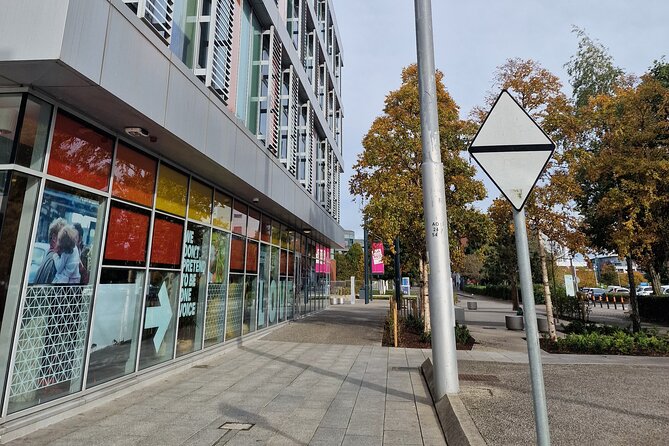
At TU Dublin’s Tallaght Campus, the tour takes a broader look at the area’s transformation. In just a few decades, Tallaght changed from a largely rural setting into one of Ireland’s largest urban areas.
During the 1980s, it was among the fastest-growing urban centres in Western Europe. That growth happened during a difficult period for Ireland, with economic strain, high unemployment, and heavy emigration.
This context matters. New housing and services did not appear in an easy or settled period. Rapid expansion brought opportunity, but it also created pressure for people and institutions trying to keep up. The walk considers how Tallaght changed from the 1970s onward and how its population experienced that change.
The campus is a useful place to discuss this shift because it represents the modern town and its expanding services. You also get a chance to compare what you see now with the smaller rural setting that existed before the large-scale building period.
The tour does not reduce Tallaght to either a success story or a problem area. It treats the town as a place shaped by work, housing, education, industry, and population growth. That balanced approach is one reason this walk can appeal to Dublin residents as well as people seeing the area for the first time.
St Maelruain’s and Tallaght’s monastic beginnings
At St Maelruain’s Church of Ireland, the route returns to early Irish history. The church occupies the site of a former monastery, an important religious centre in ancient Ireland.
The monastery, together with the one at Finglas, was known as the two eyes of Ireland. Sophie explains the setting, the life of St Maelruain, and how the present church came into being.
This short stop helps connect modern Tallaght with its earliest recorded religious past. It also makes clear that Tallaght was not simply built as a twentieth-century suburb. Its importance reaches back many centuries.
The stop lasts about five minutes, so expect a compact introduction rather than a long church visit. The attraction is the historical setting and the explanation of what came before the present building.
Alice Furlong, Irish poetry, and a recovered voice
The church grounds also contain the grave of Alice Furlong, a poet, writer, and Irish-language advocate. She was a founding member and vice-president of Inghinidhe na hÉireann, or Daughters of Ireland.
Her story is especially suited to this tour because her love of the Irish language was closely linked with her connection to Tallaght. Sophie shares examples of Furlong’s poetry in Irish, with professional English translations, as well as work written in English.
This stop gives the tour another strong female literary voice after Katharine Tynan. It also shows how political activity, cultural work, language, and local identity overlapped in Ireland.
The walk presents Furlong as someone who had been overlooked for a long time, making the grave an important place to pause. The stop lasts about 15 minutes, enough time to hear about her public work and poetry without turning the experience into a formal literary lecture.
The Fenian Rising in Tallaght Village
In Tallaght Village, a plaque marks the Fenian Rising of 1867. Sophie uses it to explain the period and Tallaght’s part in it.
This is also where Charles Dickens enters the story again. His writings on the period add an outside perspective to the events and help place Tallaght within the wider political tensions of nineteenth-century Ireland.
A plaque can be easy to pass without noticing. The guide turns it into a doorway to a larger story about resistance, politics, and how national events played out in local places. The stop lasts about 10 minutes.
Because the tour covers several centuries, each subject is presented as a concise chapter. That keeps the walk moving, though anyone wanting a detailed military or political study will need more time elsewhere.
Cottages, the steam tram, and a few words of Irish
The final stop remains in Tallaght Village. You see cottages designed by architect Thomas Joseph Byrne, described as one of the most influential architects of his day.
The route also touches on the former Dublin and Blessington Steam Tramway, which ran through the area before closing in 1932. The tramway helps explain earlier links between Tallaght and Dublin, long before the modern suburban expansion.
The tour ends with basic Irish language instruction. You can use the phrases at a bilingual Irish-English café beside the ending point in the heart of Tallaght Village.
That is a friendly and useful finish. The language lesson is brief, so do not expect a full Irish class. Instead, you leave with a few words and a clearer sense of how language remains part of local identity.
Is the $18.05 price good value?
At $18.05 per person, this is inexpensive for a two-hour guided experience, particularly with a maximum group of 12. The value comes from the range of material Sophie brings together: writers, journalists, mythology, religion, aviation, factories, political history, architecture, transport, and language.
You are not paying for entry to a major attraction. All stops are viewed from public areas, and admission tickets are not needed. The price pays for local interpretation, prepared source material, and a route that would be difficult to understand on your own.
I would not choose it if your main goal is grand architecture, museum interiors, or famous central Dublin sights. I would choose it if you want an affordable way to see how a less-visited part of Dublin developed and why its past matters.
The tour is offered in English, with Irish included in selected stories and poems. Service animals are allowed, and most people can take part, but you should remember that this is an outdoor walk and requires suitable weather.
You can cancel up to 24 hours before the start for a full refund. If poor weather forces cancellation, you are offered another date or a full refund.
Who should book this Tallaght experience?
I would recommend it to anyone interested in local Irish history, literature, language, and social change. It is also a good choice for Dublin residents who know Tallaght only by reputation or transport routes and want a better understanding of the area.
The tour suits solo visitors, couples, and small groups who prefer conversation over a large scripted excursion. The limited group size is helpful for questions, especially when Sophie is sharing letters, poems, photographs, and historical detail.
It may be less suitable if you want a gentle stroll with little talking. The route covers a great deal in two hours, and the material is broad. Wear practical shoes, prepare for outdoor conditions, and keep an open mind about what counts as a sight.
Should you book the Hidden Gem Walking Tour?
Book it if you want the other side of Dublin: a place of monasteries, poets, war correspondents, factories, political unrest, and fast urban growth. Sophie’s local perspective gives the walk a personal focus, while the small group keeps the experience approachable.
Skip it if you are visiting Dublin for only a short time and want to stay close to the city centre’s major attractions. For everyone else, $18.05 buys a thoughtful introduction to Tallaght and a useful reminder that Irish history is often found in ordinary streets, former worksites, and overlooked village corners.
FAQ
Where does the tour begin?
The tour begins in Kingswood Heights, Kilnamanagh, Dublin, County Dublin.
Where does the tour end?
It ends in Tallaght Village on R819, beside a bilingual Irish-English café.
How long does the walking tour last?
The experience lasts approximately two hours.
How much does the tour cost?
The listed price is $18.05 per person.
What language is the tour offered in?
The tour is offered in English. Irish is also included through bilingual storytelling, poetry, and basic language instruction.
How large is the group?
The tour has a maximum of 12 participants.
Who guides the experience?
The local guide is Sophie.
Can I cancel for a refund?
Yes. You can cancel at least 24 hours before the start time for a full refund. If poor weather cancels the experience, you are offered another date or a full refund.
Just added around Dublin
- Wicklow Mountains Private Day Tour including Glendalough★ 5.0 · 7 reviews
- Wicklow: Private Day Tour from Dublin★ 5.0 · 5 reviews
- Women Of Ireland: Trailblazers & Pioneers★ 5.0 · 4 reviews
- Wicklow Mountains & Glendalough Luxury Private Day Tour★ 5.0 · 23 reviews
- Wicklow tour of Glendalough★ 4.5 · 8 reviews
- Premium Irish Whiskey Tasting Hosted by Local Dublin Expert★ 5.0 · 77 reviews
- Whiskey Tasting Tour of Dublin★ 5.0 · 117 reviews
- Semi-Private (8people max) 2.5 Hr Dublin Walking Tour★ 5.0 · 69 reviews
Walking Tours, compared.
Dublin Highlights and Hidden Gems Guided Walking Tour
Read our review →

90 Minute Dublin Walking tour and Sightseeing tips
Read our review →

Dublin Traditional Irish 3 Course Meal Walking Tour with Local
Read our review →
Browse the lists this tour appears in