
Reviewed · WALKING TOURS
Dublin: Bucket List Sights Walking Tour
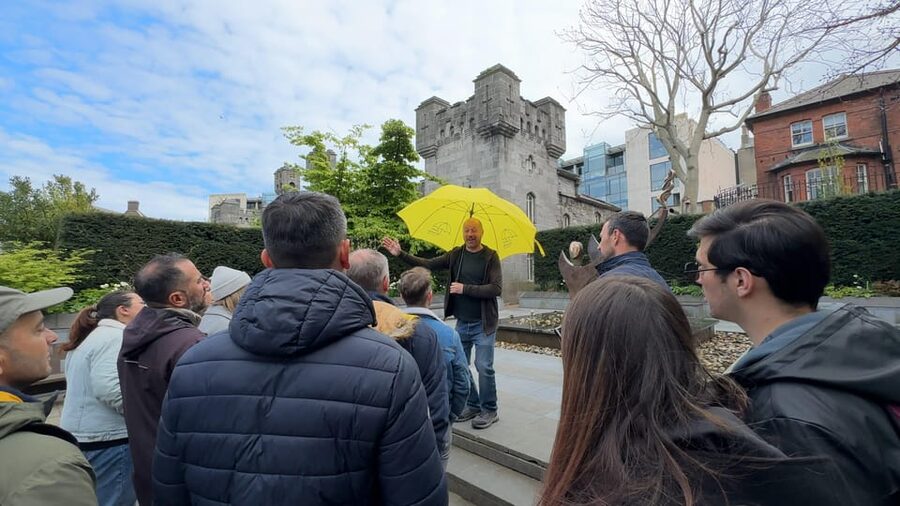
Dublin’s story is packed into this two-hour walk: Viking beginnings, Norman building, British rule, Irish independence, lively pubs, and today’s Silicon Docks. You move from Christchurch Cathedral and Dublin Castle to Temple Bar, College Green, Molly Malone, and the front gate of Trinity College.
I like the route’s strong sense of place, especially the link between the Viking harbor at Dubh Linn, the castle courtyards, and the modern city across the River Liffey. I also like the personal touch from guide Peter, who answers questions, adjusts his English to your level, and offers tips for the rest of your stay. The drawback is simple: two hours is enough for an introduction, not a full visit inside every major sight.
Key points at a glance
- Viking roots at Christchurch Cathedral: Begin near one of Dublin’s oldest major landmarks, with a story that reaches back to a wooden Viking church.
- Dublin Castle in two architectural worlds: See medieval and Georgian details in the courtyards of the former center of British government in Ireland.
- Temple Bar without making it the whole tour: Walk through the famous pub district, then continue into less obvious parts of the old center.
- A view across centuries: From the north side of the Liffey, the tour connects the Celtic settlement, Georgian Dublin, and the modern Silicon Docks.
- Trinity College finish: End outside the college linked with the Book of Kells exhibition, a useful place to continue sightseeing on your own.
- A flexible, low-cost introduction: At $19 per person, the tour gives you a guided framework before you decide which sights deserve admission fees and extra time.
Why this route works for a first look at Dublin
This tour is built around orientation. You are not simply taken from one famous building to another. The guide links the old city’s religious, political, commercial, and social layers as you walk.
Dublin was first settled by the Celts about 2,100 years ago. Later came Christian communities, Vikings, Normans, English rule, Irish independence, and the American influence connected with the Silicon Docks. That sequence gives the walk a useful shape. You can see how Dublin changed instead of treating each landmark as a separate photo stop.
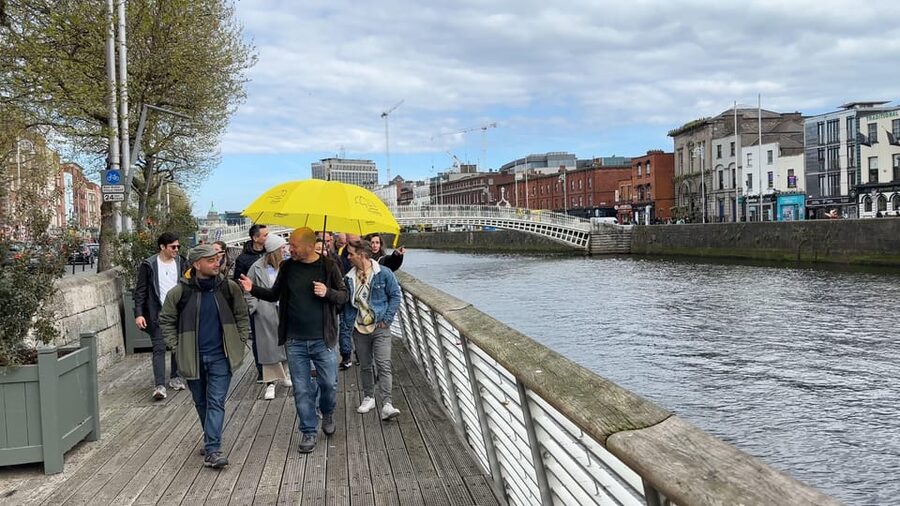
The route also crosses the River Liffey and returns by the Ha’Penny Bridge. That matters because Dublin can feel divided between its historic south side and the commercial streets north of the river. The crossing gives you a broader view than a walk that stays around Temple Bar.
You should expect a steady city walk rather than a slow museum tour. The guide leads you through public streets, courtyards, bridges, squares, and church surroundings. Since the tour lasts two hours, the emphasis is on explanation and outside views. Admission to the cathedrals, the Chester Beatty Library, Dublin Castle interiors, or the Book of Kells exhibition is not included.
More Walking Tours in Dublin
- Dublin Highlights and Hidden Gems Guided Walking Tour
★ 5.0 · 6,020 reviews - Dublin: Highlights and Hidden Gems Walking Tour
★ 4.9 · 2,140 reviews - 1916 Rebellion Walking Tour
★ 5.0 · 1,605 reviews
Christchurch Cathedral and Dublin’s Viking beginning
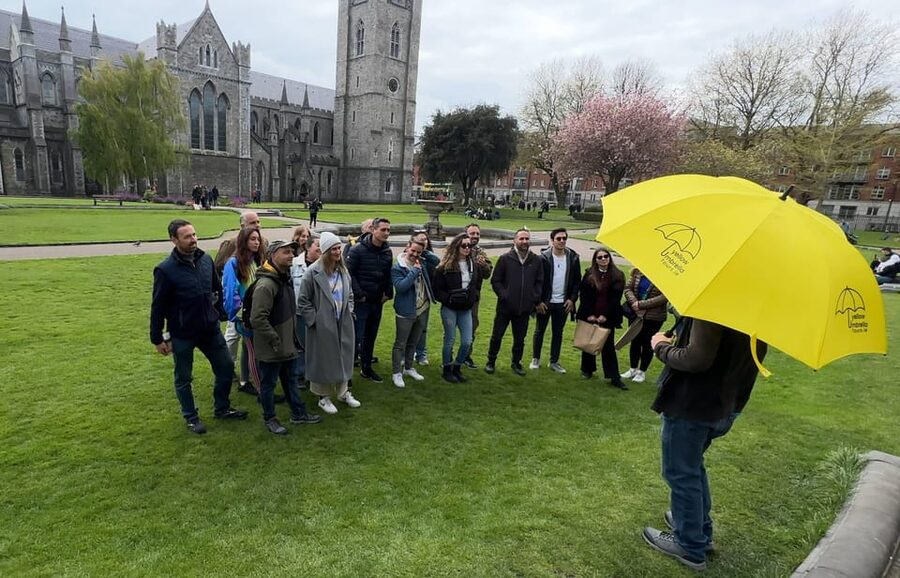
Meet your guide across the road from Christchurch Cathedral, outside the Bull and Castle. Look for the yellow umbrella. This clear meeting point is helpful in a busy central area, though you should arrive with enough time to identify the guide before the walk begins.
Christchurch is a strong place to start. The cathedral’s story reaches back to the Vikings, who first built a wooden church here about a thousand years ago. The Normans later rebuilt it in stone, and the building you see today also reflects a major 19th-century Gothic restoration connected with the whiskey wealth of Henry Roe.
That mix gives the first stop real depth. The cathedral is not presented as one untouched medieval building. It is a place shaped by several periods, much like Dublin itself.
You will admire the cathedral from the outside as part of the walk. If you want to go inside, check separately for admission and opening details. The tour’s $19 price remains reasonable partly because it concentrates on the city’s story without folding several entrance tickets into the cost.
St. Patrick’s Cathedral and Jonathan Swift
The next major stop is St. Patrick’s Cathedral, named for Ireland’s patron saint. The tour includes the story of Saint Patrick and the familiar tradition that he banished snakes from the island.
The cathedral is also tied to Jonathan Swift, author of Gulliver’s Travels and a former dean. That connection gives the building a literary angle, not just a religious one. You also hear how Sir Benjamin Lee Guinness helped fund a major restoration in the 1860s.
I like this stop because it shows how Dublin’s famous names overlap. Saints, writers, brewing families, and political figures all appear in the city center, often within a short walk of one another.
Again, plan on an exterior visit unless you arrange separate entry. If you want substantial time inside both cathedrals, this walking tour should be the beginning of your day, not your only cathedral visit.
Dubh Linn Garden and the Chester Beatty Library

From St. Patrick’s, the route continues to Dubh Linn Garden. The name connects to the Viking mooring place for longboats, dating back about 1,200 years. This is a useful pause because it lets you picture the water and settlement patterns behind the modern streets.
The nearby Chester Beatty Library is another important point of reference. The tour identifies it as an outstanding cultural institution, but the walk does not include a detailed visit inside. You can note it as a possible return stop if its collections interest you.
This part of the route rewards people who like small pieces of context. A garden or paved civic space can seem ordinary until you learn why the name matters. Here, the guide helps connect the present-day setting with the Viking settlement that shaped Dublin’s name and early growth.
More walking routes in Dublin:
- 90 Minute Dublin Walking tour and Sightseeing tips
★ 5.0 · 916 reviews - 2-Hour Historical Walking Tour from Dublin
★ 5.0 · 875 reviews - Historical 2-Hour Guided Walking Tour of Dublin
★ 4.7 · 865 reviews - Dublin Traditional Irish 3 Course Meal Walking Tour with Local
★ 5.0 · 755 reviews
Dublin Castle, from British rule to Irish independence
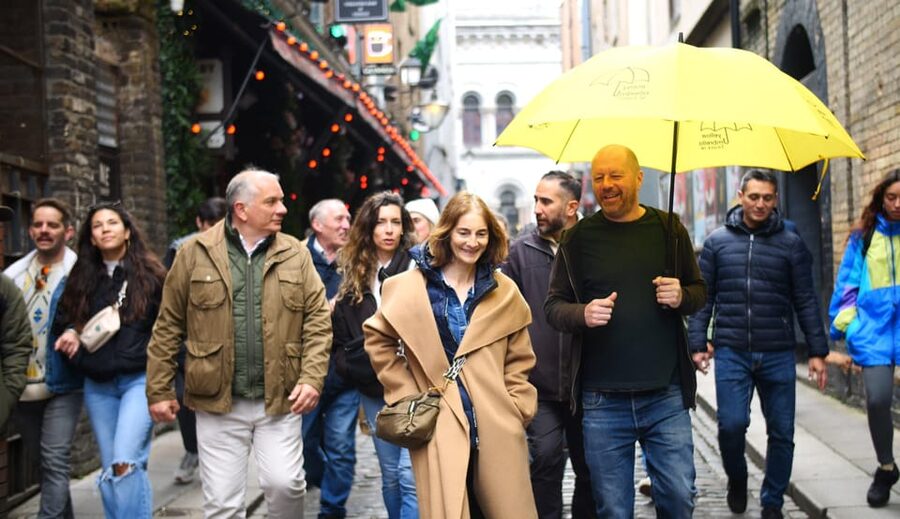
Dublin Castle brings the political story into focus. The route passes through both the lower and upper courtyards, where medieval and Georgian architecture meet.
For about 700 years, the castle served as the seat of British government in Ireland. In 1922, it was handed over to Michael Collins and the Irish Free State after independence. That political handover gives the stop weight. You are not only looking at an old government complex. You are standing at a place tied to the shift from British rule to an independent Irish state.
The courtyards are especially useful on a short tour because you can see more than one architectural period without traveling far. The medieval elements point to an older Dublin, while the Georgian work reflects a later era of government and administration.
The main limitation is time. The guide can explain the castle’s role and show you the key exterior areas, but two hours does not allow for an unhurried castle visit. If the interiors are high on your list, return separately.
Temple Bar, pubs, and the city’s social side
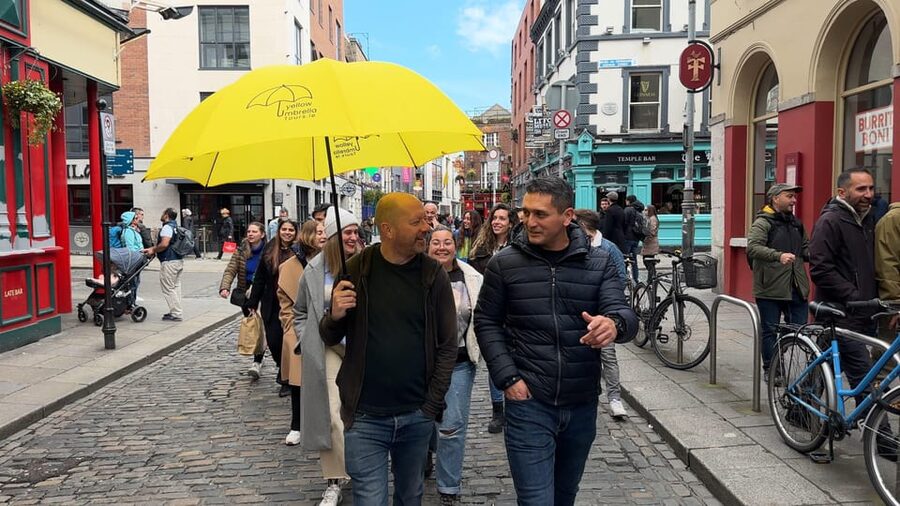
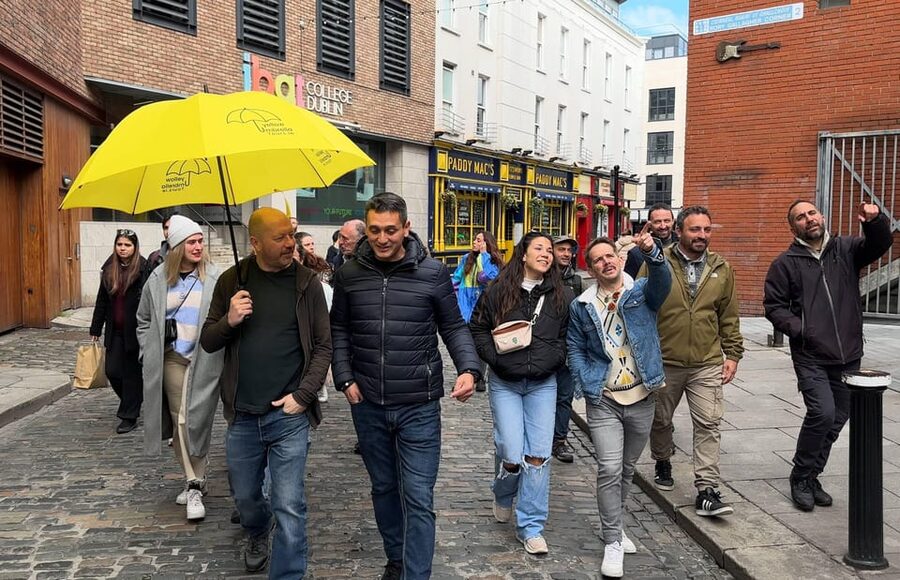
Temple Bar is one of Dublin’s most famous districts, known for live music, pubs, and nightlife. It is also among the oldest parts of the city, with roots connected to the Tudor conquest in the 16th century.
This is where the tour shifts from formal institutions to everyday Dublin. You see the district as a place for evening entertainment, but the guide also places it within the longer story of the city.
Temple Bar can be crowded and noisy, especially at popular times. That may be part of its appeal, but it can also make a detailed explanation harder to hear. The route does not end here, which is a plus. You get a look at the famous district without giving up the rest of the old center to pub streets.
If you want live music later, use the tour to get your bearings, then return when you have time to choose a pub at your own pace. The walk itself is not a pub crawl.
The Liffey, the north side, and modern Dublin
The route crosses the River Liffey to the north side for a city view that reaches from the original Celtic settlement to the Silicon Docks. This is one of the more valuable parts of the itinerary because it widens your sense of Dublin.
The Silicon Docks represent the city’s 21st-century American influence. Set beside the Celtic and Viking stories, that modern reference helps show that Dublin is not frozen in its old center. The city has moved from settlement and river trade to government, finance, technology, and international business.
You then cross back over the iconic Ha’Penny Bridge and pass through Merchant’s Arch toward Crown Alley. Along the way, the tour considers Sam Stephenson’s Central Plaza, a large example of brutalist architecture.
That contrast may appeal to you if you like cities as working places, not just collections of pretty historic buildings. Central Plaza will not please everyone, and the guide’s attention to it may be more interesting to architecture fans than to people looking only for classic Georgian facades.
College Green and Dublin’s Georgian center

At College Green, the route reaches some of Dublin’s finest neoclassical Georgian architecture. The buildings here reflect the area’s former role as a center of government and finance for a city that saw itself as the second city of the Empire.
This stop gives you a chance to look up. Banks, public buildings, and former political institutions create a formal urban setting quite different from Temple Bar’s narrow pub streets.
I find this change of mood useful. The tour does not present Dublin as only medieval or only literary. It shows the city’s ambitions, wealth, and political position during the Georgian period, then places those ideas beside the later story of independence.
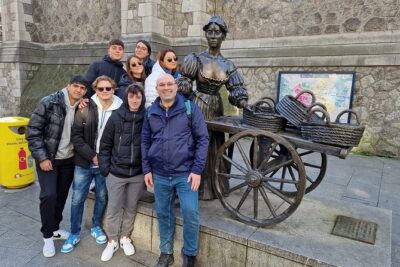
The walk continues to Molly Malone outside St. Andrew’s Church. Dublin’s favorite daughter is an easy landmark and a light moment after the heavier political history. She also helps connect the grand buildings with the popular stories and characters that shape the city’s public identity.
Ending at Trinity College and the Book of Kells
The final stop is outside the front gate of Trinity College. The college is home to the famous Book of Kells exhibition, so the ending works well for anyone who wants to continue sightseeing after the guide says goodbye.
The tour does not include entry to the exhibition. That is important when planning your day. You finish outside the college, with the option to decide for yourself if the exhibition fits your schedule and interests.
Ending here is practical. Trinity College is a major Dublin landmark, and you have already covered the old center, the river, Temple Bar, College Green, and several religious and political sites. The activity then returns to the original meeting point, so you can also retrace your steps or continue exploring from central Dublin.
Guide style and what the $19 price buys you
The guide speaks English, and Peter is the named guide connected with the strongest personal feedback. His approach is conversational: he asks about you, answers additional questions, and offers suggestions for what to do and where to go during the rest of your stay.
That personal help may be especially useful if English is not your first language. Peter has adjusted the tour to a participant’s level of English, which can make a history-heavy walk easier to follow.
At $19 per person, I see this as a good-value orientation tour. You get two hours of guiding across several of Dublin’s most important districts, with a route that would be difficult to organize efficiently on your own. The price does not include attraction admission, but that keeps the initial cost low and lets you choose where to spend more.
The rating is based on six reviews, so I would not treat it as a large statistical record. Still, the repeated praise points to the same useful qualities: Peter’s kindness, clear historical explanations, flexibility with questions, and practical advice.
The walk is wheelchair accessible, and free cancellation is available up to 24 hours before the start for a full refund. You can also reserve now and pay later, which helps if your Dublin plans are still shifting.
Who should book this Dublin walk?
I would choose this tour if you are visiting Dublin for the first time and want a clear framework before exploring independently. It suits people who like history but do not want to spend the whole day inside museums or formal attractions.
It also works well for a short stay. In two hours, you cover the central landmarks most likely to appear on a first Dublin itinerary. You can then return to the cathedral, castle, Chester Beatty Library, or Trinity College with a better sense of their place in the city.
You may want something else if you prefer a very slow pace, long interior visits, or a small specialist subject such as Irish literature, architecture, or political history. The tour covers a lot of ground, so some stops receive explanation rather than extended exploration.
Wear comfortable shoes and keep your schedule flexible after the finish. The route includes city streets, courtyards, bridges, and several districts, and the best value comes from treating it as an introduction rather than a complete Dublin sightseeing day.
Should you book it?
Book this tour if you want an affordable, story-led walk that connects Dublin’s Vikings, churches, castle, pubs, Georgian institutions, independence, and modern technology. The route is broad, the meeting point is easy to find, and the finish outside Trinity College gives you a useful next stop.
Skip it if you already know central Dublin well or want admission time at each major sight. For most first-time visitors, though, $19 is a sensible price for two hours of orientation, especially if you value a guide who can adjust explanations, answer questions, and point you toward good choices for the rest of your stay.
FAQ
How long is the Dublin Bucket List Sights Walking Tour?
The tour lasts two hours. Starting times vary, so check availability when booking.
Where does the tour begin?
Meet your guide across the road from Christchurch Cathedral, outside the Bull and Castle. Look for the yellow umbrella.
Where does the tour end?
The walk ends back at the original meeting point.
What language is the tour conducted in?
The live tour guide speaks English, and English is the listed tour language.
Does the tour include entry to the Book of Kells exhibition?
No. The tour finishes outside Trinity College, home of the Book of Kells exhibition, but admission to the exhibition is not included in the stated activity details.
Is the walking tour wheelchair accessible?
Yes. The activity is listed as wheelchair accessible.
Can I cancel the tour for a full refund?
Yes. You can cancel up to 24 hours in advance for a full refund. You can also reserve now and pay later.
Just added around Dublin
- Gin School, distill you own gin, cocktails, tastings, food★ 5.0 · 8 reviews
- Dublin : Street Art Walking Tour★ 5.0 · 3 reviews
- Dublin: Personal Photographer- Travel Photography Experience★ 4.5 · 8 reviews
- Dublin: Skip-the-line Book of Kells & Old Town Private Tour★ 5.0 · 6 reviews
- Dublin: Howth Coastal Craft Beer and Seafood Tour★ 5.0 · 62 reviews
- Vikings In Dublin (Walking Tour)★ 5.0 · 8 reviews
- Dublin: Silent Disco Walking Tour★ 4.9 · 21 reviews
- Dublin: Private Tour of City Monuments in Spanish★ 5.0 · 6 reviews
Walking Tours, compared.
Dublin Highlights and Hidden Gems Guided Walking Tour
Read our review →

90 Minute Dublin Walking tour and Sightseeing tips
Read our review →

Dublin Traditional Irish 3 Course Meal Walking Tour with Local
Read our review →
Browse the lists this tour appears in