
Reviewed · IRELAND
Maria Edgeworth Center-A Self-Guided Audio Tour
Maria Edgeworth’s story reaches well beyond novels. At this small centre in Edgeworthstown, you’ll meet an author who ranked alongside Jane Austen and Byron in her own day, then see how her family helped push education forward in Ireland. The setting is an old school building, so the subject feels tied to the place rather than packed into a generic display.
I like the clear audio format, which lets you move at your own pace, and the 19th-century classroom recreation, where the story of hedge schools and Ireland’s early primary system becomes easier to picture. The main thing to consider is that this is a modest local centre, not a large museum. If you skim displays, you may finish quickly. If you read the letters and family material carefully, plan extra time.
Key things to know before you go
- Maria Edgeworth takes center stage: Learn about one of the most successful English-language novelists of her era, a contemporary of Jane Austen and Lord Byron.
- The old schoolroom matters: The centre occupies a school building dating from 1840, with a recreated classroom that explains Ireland’s hedge-school tradition.
- The family story is bigger than literature: Richard Lovell Edgeworth and other family members worked in education, science, invention, and public life.
- The audio tour is self-paced: The advertised visit takes about one to one and a half hours, but the letters, portraits, and books can keep you there longer.
- Matt and Janine add a personal welcome: Staff members have been praised for explaining the family story and helping visitors connect the displays to local history.
- The price is easy to justify: At $9 per person, admission costs less than many major Irish attractions and gives you a focused look at an important local figure.
Meeting Maria Edgeworth in Edgeworthstown
The Maria Edgeworth Centre offers a useful correction to the usual Irish literary itinerary. Dublin, Galway, and County Sligo often claim the attention, while Edgeworthstown gives you a closer look at an author whose reputation was once enormous.
Maria Edgeworth was one of the leading English-language novelists of her time. Her name belongs in the same conversation as Jane Austen and Byron, yet many modern visitors know little about her before arriving. The centre fixes that gap with a mix of audio narration, pictures, letters, books, family information, and objects from the 18th century onward.
I like the way the visit links Maria’s writing to the people around her. Her father, Richard Lovell Edgeworth, was an inventor, surveyor, and educator. He helped shape the intellectual setting in which Maria worked, and the family’s interests reached far beyond literature.
That family setting is important. Maria did not develop in isolation. The centre presents an Edgeworth household concerned with education, science, social improvement, and the exchange of ideas. You get a portrait of a busy, forward-looking family rather than a single author presented on a pedestal.
A few more things to do around Ireland worth a look
- St Patrick’s Cathedral: Self-Guided Cathedral Admission
★ 4.5 · 2,126 reviews - Christ Church Cathedral Entrance Ticket & Self-Guided Tour
★ 4.6 · 773 reviews - Self-Guided Bike Tour of Killarney National Park, Muckross Gardens & Waterfall
★ 5.0 · 223 reviews
Inside the 1840 school building
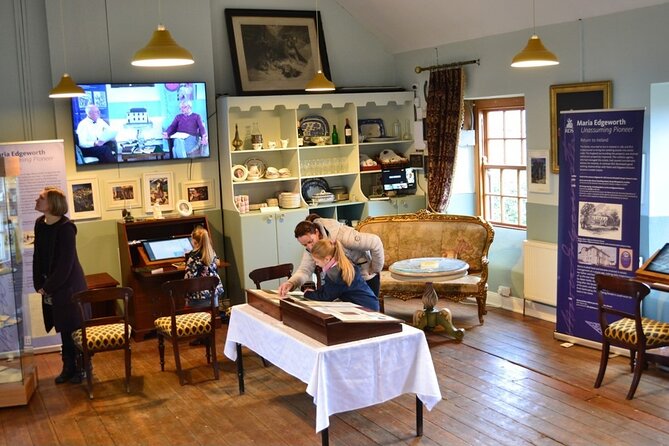
The building gives the visit its strongest sense of place. The centre is housed in an old school building dating from 1840, and part of the presentation recreates a 19th-century schoolroom.
This is more than a decorative backdrop. The classroom helps explain the conditions in which Irish education developed. You’ll hear about hedge schools, informal schools that operated outside the later national system, and about the Edgeworth family’s efforts to make education a government priority.
The displays also cover the creation of Ireland’s Primary School System in 1831. The Edgeworth family played an important role in that story, so the education section gives you a second way to understand Maria’s importance. She was not only a novelist. She was connected to wider arguments about how children should learn and who should have access to education.
I find this part especially useful if you are interested in social history. The old desks and classroom setting make the subject concrete, while the audio explains the larger issues. You are not simply looking at old books. You are seeing how literature, family influence, and public education overlapped in 19th-century Ireland.
How the self-guided audio tour works
The audio tour lets you set the pace. The stated visit lasts about one hour to one hour and 30 minutes, which makes it easy to fit into a day of exploring County Longford or into a short stop in Edgeworthstown.
You can pause over portraits, letters, and books instead of being hurried from one display to the next. That matters here because the material rewards attention. A quick pass gives you the broad outline of Maria’s life, while a slower visit helps you sort out the family relationships and the links between the Edgeworths and Irish education.
The audio also brings in Edgeworthstown’s connections with other well-known figures. You’ll hear about links to Oliver Goldsmith, Sir Walter Scott, William Wordsworth, and Oscar Wilde. These connections place Maria and her family within a wider literary world, rather than treating them as an isolated local story.
The format is offered in English. If you prefer a live guide who can answer questions as you go, this may feel less personal than a scheduled walking tour. Still, staff members such as Matt and Janine can add useful context at the centre, and the self-guided structure gives you more freedom to stop, reread, or return to a display.
The displays: portraits, letters, and family objects
The centre contains portraits, books, letters, and family artifacts, including objects dating back to the 18th century. The material is varied enough to make the family story feel tangible.
Maria’s writing is naturally the focus, but the displays also help you understand the people who surrounded her. You’ll see how the Edgeworth household connected literary work with education and practical innovation. The family tree can take some sorting out, especially if you arrive already interested in Maria’s correspondence or genealogy.
This is a good place to slow down. The centre is not huge, so you may be tempted to finish in a few minutes. I would allow time to read the information panels and look closely at the letters. One visitor spent roughly three hours with the audio, pictures, and correspondence. That is longer than the usual estimate, but it shows how much there is for readers who enjoy documents and family detail.
The collection also works well for people tracing local or family connections. The Edgeworth name is tied to Edgeworthstown, and the centre helps connect the literary figure to the town around her. If your own family research brings you to the area, the visit can give a useful historical frame to names and places you have encountered elsewhere.
Same base, a very different sort of day:
- Dublin to Cliffs of Moher, including Wild Atlantic Way and Galway
★ 5.0 · 23,331 reviews - From Dublin: Cliffs of Moher, Burren & Galway City Day Tour
★ 4.8 · 18,888 reviews - Dublin: Guinness Storehouse Entry Ticket
★ 4.6 · 16,863 reviews - Dublin to Cliffs of Moher, Burren, Wild Atlantic Way, Galway Tour
★ 5.0 · 12,924 reviews
Why the education story is worth your time
Many literary museums focus tightly on an author’s books. This one gains strength by explaining the Edgeworth family’s work in education.
The recreated classroom introduces the hedge-school tradition and the long effort to create a more organized national system. The 1831 Primary School System provides a key date, and the Edgeworth family’s role helps show that education was an active public issue, not a settled matter.
You’ll also see why Maria’s reputation should not be reduced to a footnote beside Jane Austen. Her family environment supported serious thought about teaching, childhood, social class, and public responsibility. Even if you have not read her novels, the education material gives you a reason to care about her place in Irish history.
I especially like this wider lens for families and school-age children. The old classroom offers something they can see, while the audio explains why schooling looked different in earlier Ireland. The centre does not require you to arrive as a Maria Edgeworth expert.
Links to Austen, Scott, Goldsmith, and Wilde
Maria’s connections with major literary names help you place her in time. The centre brings in Oliver Goldsmith, Sir Walter Scott, William Wordsworth, Oscar Wilde, Jane Austen, and Byron.
These names are not just a list of famous people. They show the scale of Maria’s literary world and the level at which she was working. She was part of a period when letters, books, family networks, and personal introductions helped ideas travel across Britain and Ireland.
The connection with Jane Austen will be familiar to many visitors, but the centre gives Maria her own identity. It does not simply present her as another author from Austen’s era. You’ll learn about her own family, her own setting, and her own role in Irish literary and educational life.
If you enjoy reading historic correspondence, the letters and written material are likely to be among the most rewarding parts. If you prefer broad storytelling to close reading, the audio gives you enough structure to keep the visit moving.
Staff welcome from Matt and Janine
Although the experience is self-guided, the welcome at the centre can make a difference. Matt has led historical walks around Edgeworthstown, and a visit may be paired with a town walk before you enter the centre. Janine has also been praised for explaining Maria, her parents, and the family’s achievements in a warm and accessible way.
Do not expect a large visitor operation with a full team on hand at every moment. This is a local centre, and the personal scale is part of its appeal. Staff enthusiasm helps the displays feel connected to the living town.
If you have questions about the family tree, local history, or the education displays, ask while you are there. A short explanation from someone who works with the collection can help you make sense of details that might otherwise feel scattered.
Is $9 good value?
At $9 per person, I consider this a strong-value cultural stop. The admission includes the audio experience and access to the museum displays, with no separate charge for the recreated schoolroom.
The value depends on how you use the visit. If you rush through in 30 minutes, the price may feel less compelling, even though the admission remains modest. Give yourself the full 60 to 90 minutes, and the combination of audio, artifacts, letters, portraits, and education history offers plenty for the cost.
You may also want to allow extra time if you read closely or have a family connection to the area. Tea and coffee may be available, and there is seating outside, adding a simple pause to a visit in town. Payment arrangements have been a concern at quieter times, so it is sensible to confirm the accepted payment method before you arrive if that matters to your plans.
The centre has earned a 4.9 rating from 21 ratings, with all listed recommendations positive. That figure is encouraging, but the more useful point is what the experience does well: it offers a focused story, a friendly welcome, and a subject that is easy to overlook elsewhere.
Who will enjoy this centre most?
I would choose this stop if you like literary history, local museums, family research, or the story of education in Ireland. It also suits anyone who wants a quieter cultural activity between larger attractions.
You do not need to have read Maria Edgeworth before arriving. In fact, the centre works well as an introduction. You’ll leave with enough context to choose one of her books, and the centre shop may have books connected with her life and writing.
The visit is also useful for someone who has already read about Maria. The letters, family information, and local setting give shape to the name on the page. Readers working through Valerie Pakenham’s collection of Maria’s letters may find the family tree and artifacts especially helpful.
I would be less likely to recommend it to someone seeking a large, highly interactive museum or a full-day attraction. The centre is compact, and the pleasure comes from listening, reading, and noticing connections. Its appeal is thoughtful rather than flashy.
Practical details for planning your stop
The tour is in Ireland and is offered in English. Confirmation is provided when you book, and you receive a mobile ticket.
The centre is near public transportation, and service animals are allowed. Most people can take part, although the supplied information does not give detailed access notes for every part of the building. If you have specific mobility needs, contact the Maria Edgeworth Centre before setting out.
The experience is normally booked about 36 days in advance, so reserving ahead is sensible if your Ireland itinerary is fixed. Free cancellation is available up to 24 hours before the start time. Canceling or changing the booking within 24 hours does not qualify for a refund.
The advertised duration is one hour to one hour and 30 minutes. I would avoid scheduling a tight connection immediately afterward, especially if you enjoy letters, portraits, and family history. The centre is easy to underestimate.
Should you book the Maria Edgeworth Centre?
Book it if you want a personal-scale museum that connects one author with Irish education, local history, and a remarkable family. The $9 price is fair, the audio gives you control, and the old schoolroom adds a strong sense of place.
I would make this a priority for readers, educators, people tracing family connections, and anyone curious about the lesser-known side of Ireland’s literary past. If your schedule is packed with major sights, it is still a worthwhile one-hour stop, but give it closer to 90 minutes if you want to absorb the documents and family story.
Skip it only if you need a large attraction with constant activity or a live guide throughout. For everyone else, the Maria Edgeworth Centre offers a clear, affordable way to meet an important Irish writer and understand the family that helped shape education in her country.
FAQ
How long does the Maria Edgeworth Centre audio tour take?
The experience takes approximately one hour to one hour and 30 minutes. You may need longer if you read the letters, portraits, and other displays carefully.
How much does admission cost?
The price is $9 per person. Admission to the Maria Edgeworth Visitor Centre is included.
Is the tour self-guided?
Yes. The visit uses a self-guided audio tour, allowing you to move through the centre at your own pace.
What language is the audio tour offered in?
The experience is offered in English.
Who was Maria Edgeworth?
Maria Edgeworth was a highly successful English-language novelist of her era and a contemporary of Jane Austen and Byron. The centre also explains her family’s work in education and public life.
What will I see at the centre?
You will see portraits, books, letters, family artifacts, and a recreation of a 19th-century schoolroom. The displays cover Maria Edgeworth’s life, Edgeworthstown’s past, Irish hedge schools, and the development of the Primary School System in 1831.
Can I cancel the booking?
Yes. You can cancel up to 24 hours before the experience’s start time for a full refund. Cancellations or changes made less than 24 hours before the start time are not accepted for a refund.
Just added around Ireland
- Westport: Fun-filled walking tour of a beautiful town★ 5.0 · 7 reviews
- Wicklow Mountains Private Day Tour including Glendalough★ 5.0 · 7 reviews
- Wicklow: Private Day Tour from Dublin★ 5.0 · 5 reviews
- Westport: Beach and Countryside Guided Horse Ride★ 4.8 · 6 reviews
- Waterford Treasures: Walking Tour of the Viking Triangle★ 4.7 · 43 reviews
- Waterford: The Irish Wake Museum Guided Tour★ 4.8 · 6 reviews
- Waterford Treasures: Medieval Museum Entry Ticket★ 4.5 · 20 reviews
- Valentia Island : The Experience★ 4.0 · 6 reviews